

Key Takeaways:
- Licensed teachers can add qualifications through focused coursework or a state-approved exam, often faster and more affordably than earning another degree.
- The best endorsement depends on your career goals. Special education and ESL credentials often apply across more settings, while math and science endorsements can open doors to high-need roles.
- Before enrolling, compare state approval, exam rules, reciprocity, and endorsement codes to make sure the program meets your target state’s requirements.
Most licensed teachers don’t need another full degree to qualify for a new subject area or student population. Teaching endorsements are credentials added to an existing license, and they can open classroom doors that would otherwise take years and significant expense to reach through a second degree.
Each state controls its own program requirements and content exams, so comparing accredited teaching certificate programs against your target state’s requirements is the step that protects your investment. GetEducated provides free, independent resources to help you evaluate endorsement options and make a well-informed choice.
How Teachers Earn a Teaching Endorsement
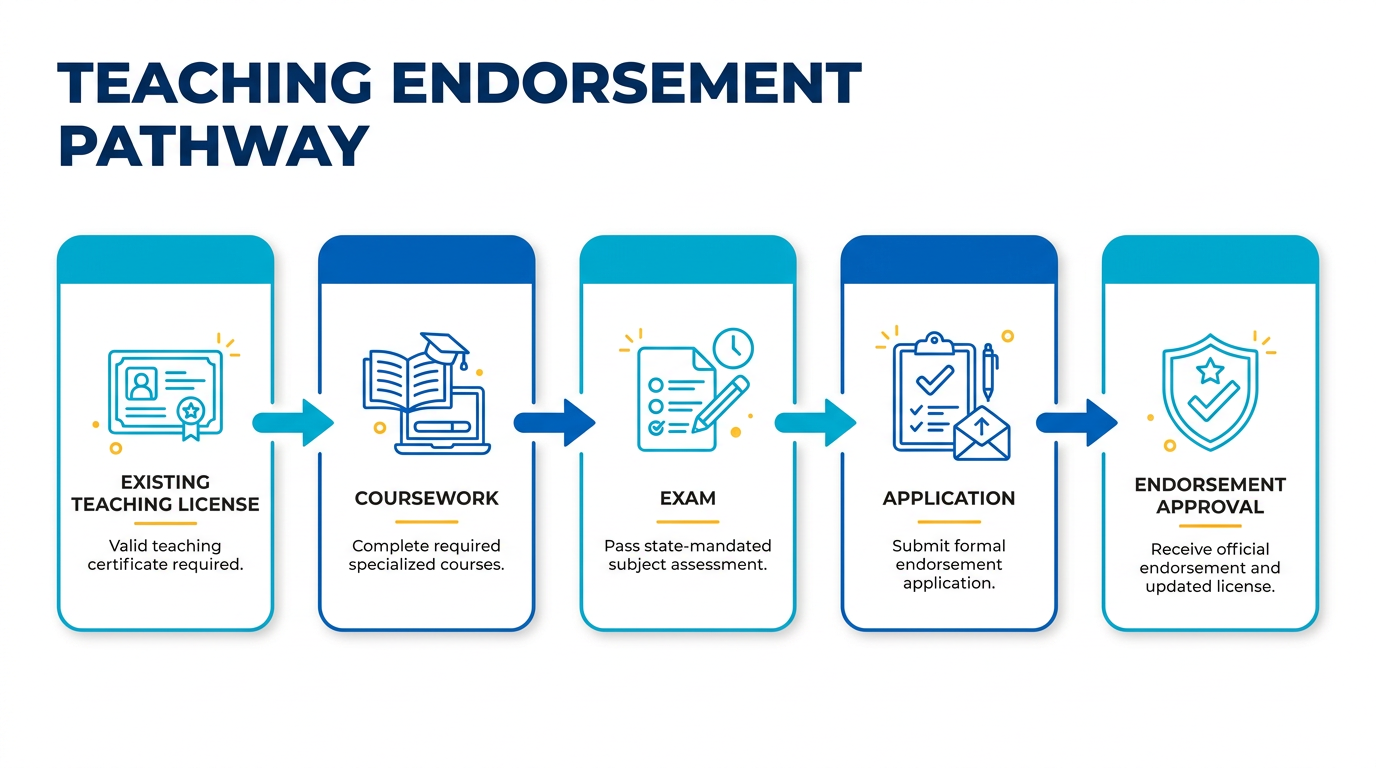
Earning a teaching endorsement doesn’t mean starting over. Most licensed teachers add one through targeted coursework or a content exam; no new degree required. Understanding which route applies to you starts with knowing what your current license, transcripts, and classroom experience already cover.
GetEducated's Picks
- East Mississippi Community College Associate of Arts (AA) - Mathematics Education Emphasis
- Lamar University Alternative Certification Program
- Campbellsville University Master of Education in Montessori Teacher Education
The Three Most Common Pathways
States generally recognize coursework-based and exam-based routes to adding an endorsement, and some states also accept post-licensure certificate programs. Washington, for example, allows teachers to add endorsements by passing the WEST-E or NES subject exam or completing an approved program with a supervised practicum. Florida offers a similar structure in which teachers can meet specialization requirements through district-approved coursework without re-enrolling in a degree program.
What Your Existing Credentials Can Count For
Your starting point matters. States often credit prior coursework, subject-area experience, or an out-of-state credential toward the new endorsement. Michigan, for instance, allows teachers with three or more years of relevant experience to waive certain exam requirements under specific conditions. Checking what your state already recognizes can shorten the path considerably.
How to Compare Programs Before You Enroll
Not every program that promises an endorsement will actually deliver one in your state. A smart comparison looks at regional accreditation and state approval, and whether the program explicitly names the endorsement code it prepares you to earn. Programs that skip those details are worth a closer look before you commit any money or time.
Types of Teaching Endorsements That Expand Your Options
Teaching endorsements fall into four main categories: subject-area, grade-band, student-population, and specialist-track. States like Arizona and Colorado organize them this way, and knowing which category fits your goals before enrolling determines whether the credential actually gets used.
Here’s how the main types break down:
- Subject-area endorsements cover specific disciplines like math, science, reading, or ESL. These are practical for teachers who want to qualify for harder-to-fill roles without entirely changing careers. An online ESL program, for example, can prepare a licensed teacher to add a bilingual or English language learner endorsement and step into a consistently high-demand classroom.
- Grade-band endorsements allow teachers to shift between instructional levels, such as moving from elementary to middle grades or from middle school to high school, when state rules permit that kind of move. Washington state, for instance, offers grade-band add-on routes, including online secondary education certificate programs that meet state-approved requirements for grade-level expansions.
- Student-population endorsements cover credentials like special education, gifted education, bilingual education, and reading intervention. These tend to offer the broadest career flexibility because they apply across multiple grade levels and school settings rather than locking you into one subject or classroom type. A special education endorsement, in particular, pairs well with almost any existing license and addresses one of the most persistent staffing shortages in public schools.
- Specialist-track endorsements sit in a separate lane in some states. Colorado, for example, requires a relevant graduate degree and documented experience for certain specialist roles, which makes them more involved than a standard add-on but potentially more valuable for teachers targeting leadership or support roles.
The category that makes the most sense for you depends on the specific job you want next, not just the subject you like best. A student-population endorsement in special education or ESL will travel more broadly across grade levels and districts than a single subject-area add-on, which matters if job security and flexibility are the goal.
That said, subject-area endorsements in high-need fields like secondary math or science carry their own labor market weight. Matching the endorsement type to both your state’s approved pathways and a real open position near you is where the planning has to start.
Why State Rules Matter Before You Enroll
Teaching endorsements do not transfer automatically across state lines. Each state controls its own licensing rules and approved programs, which means an endorsement that works in one state may not carry the same weight in another.
Before you pay for a single course, here is what to verify:
- Check reciprocity policies first: The NASDTEC Interstate Agreement supports educator mobility, but receiving states can still require extra coursework or exams.
- Confirm your endorsement code transfers: States use different code systems, and a comparable credential in one state may not map cleanly to another’s structure.
- Review state-specific exam requirements: Arizona, for example, may exempt reciprocal applicants from state exams, but only when the out-of-state credential is valid and comparable.
- Verify program approval in your target state: An online program approved in its home state is not automatically approved where you plan to teach.
- Use state profile comparisons: The Education Commission of the States publishes a 50-state reciprocity hub that makes side-by-side checking straightforward.
Doing this research before enrolling protects the time and cost advantage that endorsements offer over a full degree. The next section looks at how endorsements can affect salary and long-term career flexibility once you have confirmed the right path for your state.
Teaching Endorsements FAQs
Licensed teachers often have practical questions about what an endorsement is actually worth before they spend time and money earning one. The answers below address what matters most: whether an endorsement will improve your salary and job prospects, and when it makes more practical sense than returning for a full degree.
Can adding a teaching endorsement improve salary potential, employability, and career flexibility for licensed teachers?
Yes. Endorsements in high-need areas like special education and ESL can make you more hireable across more schools, including private schools that often have fewer staffing options. Some states also tie pay supplements to specialized credentials.
Is a teaching endorsement usually cheaper and faster than earning another master’s degree or a second bachelor’s degree?
Generally, yes. Most endorsement programs run four to eight courses and can be completed in under a year, compared to two or more years for a graduate degree. The lower course count also means lower total cost, which matters if you are balancing work and family while studying.
Which endorsement makes the most sense for teachers who want more job security without changing roles dramatically?
Student-population endorsements tend to offer the widest coverage. An online special education certification program, for example, can lead to an endorsement that applies across grade levels and school types, which gives you more options without requiring a full career pivot. It is one of the more practical choices for a teacher who wants stability and flexibility at the same time.
Do I need to meet state-specific requirements to add an endorsement, even through an online program?
Yes, and this matters. States like Michigan and Washington each have their own approved program lists and exam requirements. An online program that qualifies in one state may not satisfy another state’s rules, so confirm your state’s requirements before enrolling.
Compare Endorsement Paths Before You Commit
A teaching endorsement can move your career forward without the time or cost of another full degree, but only when the credential matches what your state actually recognizes. Paying for coursework before confirming those details is the most common and most avoidable mistake.
Compare affordable online teaching programs that are already approved for your state before enrolling. Match the teaching endorsement to a specific role you want, and check the transfer rules if you plan to work in a different state. GetEducated offers free, independent career planning resources to help you compare programs side by side and make a well-informed choice.