

Key Takeaways:
- State licensure rules come first because they determine which degree qualifies you to teach and whether an online program will count toward certification.
- A bachelor’s in history education or secondary education with a history concentration is usually the most direct path to licensure, while a plain history degree often requires extra teacher preparation.
- An online path can work, but only if the program is accredited and approved for teacher preparation in your state. It should also be transparent about in-person placement requirements and total cost.
How to become a history teacher starts with a simple truth: your state sets the rules first, and those rules decide which exams you take and whether an online program even counts. Choose a degree without checking those requirements first, and you may spend years and thousands of dollars on a path that does not qualify you to teach. Your state’s licensure requirements are the filter that determines which degree qualifies you to teach and whether an online credential will count toward certification. GetEducated helps you compare online bachelor’s programs in secondary education so you can find an option that fits your schedule and budget while meeting your state’s certification requirements.
Start With Your State’s History Teacher Licensure Rules
Before you compare tuition rates or pick a major, find out what your state actually requires. State licensure requirements for becoming a history teacher in 2026 still vary widely, and they shape nearly every decision that follows: your degree type, your program, even whether an online credential will count.
GetEducated's Picks
- Grand Canyon University Bachelor of Arts in English for Secondary Education
- Campbellsville University Master of Arts in Teaching High School Education (8-12)
- University of West Florida Master of Education in Curriculum & Instruction - Middle Level Education
Why State Rules Drive Everything Else
Each state sets its own rules, and they are not interchangeable. California, for example, requires passing the CSET subject-matter exam or completing an approved program. In contrast, Texas requires finishing a state-approved educator preparation program and passing its own certification exams. Virginia, for example, specifies the exact semester hours required for a history and social sciences endorsement, down to mandated coursework in African American history. Even if two states accept each other’s credentials through the NASDTEC Interstate Agreement, that acceptance is not automatic. Conditions apply, and your program must still meet the receiving state’s standards.
A Degree That Skips Licensure Is a Costly Mistake
Public schools require a state-issued teaching license, full stop. Choosing a degree program before checking whether it meets your state’s approval requirements is one of the most common and expensive mistakes adult learners make. Your state education agency’s website is the right starting point, not a program’s marketing page. GetEducated’s teacher certification guide breaks down how approval and accreditation intersect, a distinction that determines whether your program actually qualifies you to teach.
Four Things to Confirm Before You Apply Anywhere
You can save months of backtracking by verifying four items early. First, identify the grade level you want to teach, since middle school and high school licensing rules sometimes differ. Second, check whether your state issues a history-specific endorsement or lumps it under social studies. Third, find out how many clinical training hours are required and where placements must happen. Fourth, identify which certification exams are needed and when scores must be submitted. GetEducated’s how to Become a teacher overview walks through each of these checkpoints with practical detail.
Choose the Degree That Matches Licensure
To become a licensed history teacher, your degree needs to do two things at once: build your subject knowledge and satisfy your state’s teacher preparation requirements. Not every history-related degree does both, and choosing the wrong one is where planning either saves or costs you significant time and money.
- A bachelor’s in history education or secondary education with a history concentration is the most direct route. These programs build pedagogy and clinical training into the curriculum from the start, including supervised student teaching, which is exactly what most states require for initial licensure.
- A plain history BA builds content depth but usually falls short on its own. You can see how programs compare through this ranking of affordable online bachelor’s degrees in history. However, this route rarely includes the supervised clinical training or education coursework that state licensing boards expect, meaning you may need additional steps before you qualify to teach in a public school classroom.
- The degree must come from a state-approved educator preparation program (EPP). You can check whether a specific program holds that approval through NASDTEC’s EPP map, which links directly to each state’s official list.
- Career changers who already hold a bachelor’s degree have a practical alternative. A master’s degree with a built-in teacher licensure track, sometimes called an MAT or MEd, can fulfill preparation requirements in many states. The catch is that the program must be approved for the state where you plan to teach, so confirm that before you apply.
- Some states also set specific credit-hour thresholds for history endorsements. New Mexico, for example, requires 24 to 36 semester hours in the subject area, depending on the license type, which means the coursework inside your degree matters just as much as the degree title itself.
If you are comparing programs now, GetEducated’s directory of accredited online secondary education degrees is a practical starting point for finding options that combine history content with state-recognized teacher preparation.
Plan for Student Teaching and Certification Exams
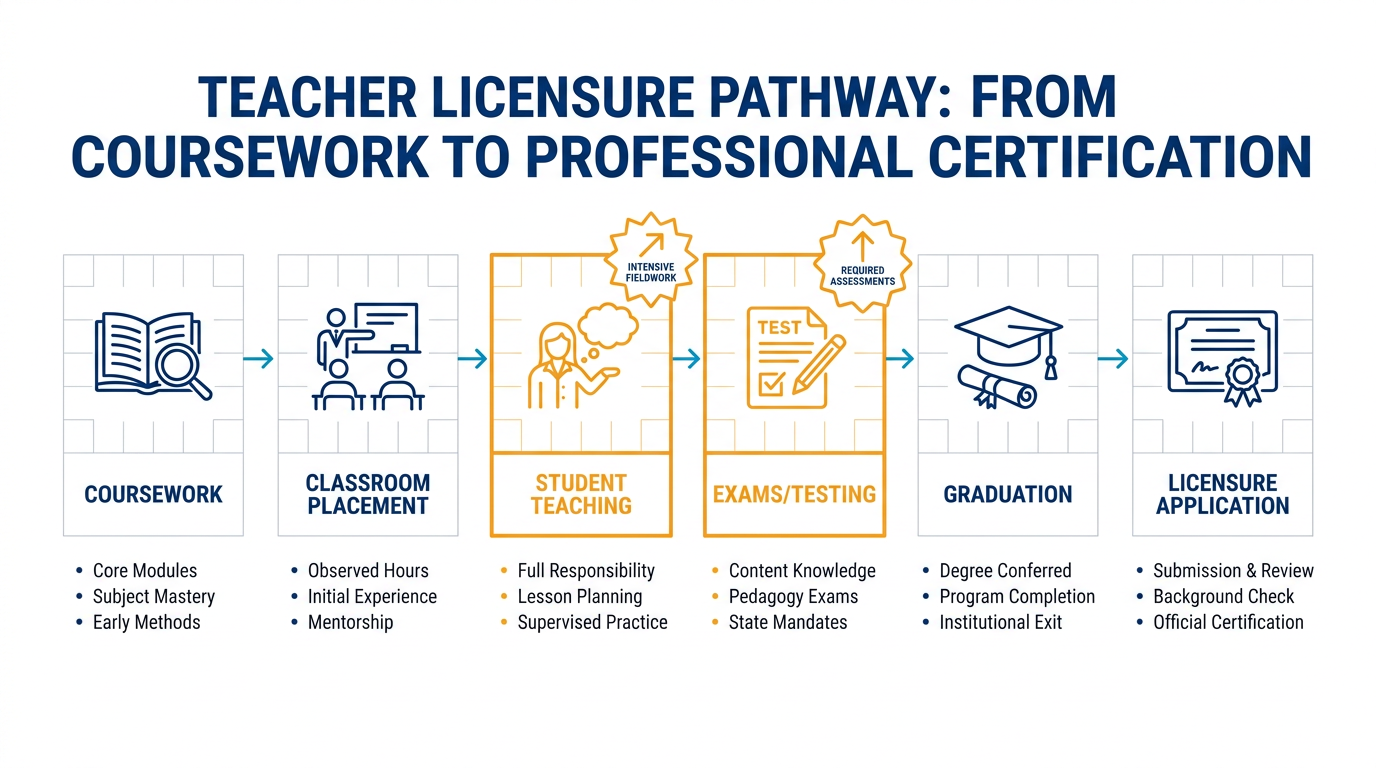
Choosing the right degree gets you most of the way there, but coursework alone is not enough to earn a public school teaching license. Most states also require you to pass certification exams and complete a supervised field placement before they will issue a license. Planning for both early in your program can save you months of unexpected delays.
Here is what to confirm before you commit to any program:
- Expect supervised student teaching to be required. Public school licensure in most states depends on classroom practice, not just academic credit. Washington State, for example, requires completion of a state-approved preparation program that includes supervised student teaching or a supervised internship before the state will process a Residency Certificate application.
- Know which certification exams apply to you. Testing requirements commonly include a basic skills exam and a subject area exam in history or social studies. Many programs also require a pedagogy exam. Some programs reference the Praxis series as the standard, though several states use their own tests. California, for instance, recently adjusted its basic-skills testing rules for degree-holders, so state-specific rules genuinely matter here.
- Check the student teaching timeline inside your program. Field placements are typically scheduled in a specific semester and may require a minimum number of hours or days in the classroom. New York sets defined hour minimums and supervision criteria for special-subject teaching certifications, and similar specifics exist in most other states.
- Confirm whether exams are due before graduation or before licensure. Some programs expect passing scores as a graduation requirement; others allow you to test after you finish. Knowing which applies to your situation lets you schedule test prep without disrupting your coursework or your field placement.
- Ask online programs how they handle placement logistics. Even online teacher certification programs require in-person student teaching. Before you enroll, browse this directory of online teacher preparation programs and ask each one whether it helps you find an approved placement site near you, or at least be transparent about what you need to arrange on your own.
The clearer you are on these requirements before you enroll, the less likely you are to finish a degree and discover it does not qualify you for licensure in your state.
 FAQs on How to Become a History Teacher
The questions below address real planning concerns that arise when you start comparing degree options and checking state rules.
Can you earn a history teacher degree online and still meet certification requirements?
Yes, in many states, but the program must be regionally accredited and state-approved for teacher preparation. It also needs to include the required clinical experience in your state, such as student teaching. States like South Carolina require pre-approval of online programs before you enroll, so confirm this step with your state education agency before you apply.
What if your state does not accept an out-of-state teacher preparation program?
Acceptance is conditional, not automatic. Many states recognize out-of-state credentials but may still require additional steps, such as extra coursework or state-specific exams. Always confirm with your state education agency before enrolling in a program based elsewhere.
Can you become a history teacher with a history degree but no education courses?
It depends on your state. Some states offer alternative certification routes designed for candidates who already hold a bachelor’s degree in a subject area. New York, for example, offers Transitional B and C certificates for this situation. These pathways vary widely, so check your state’s specific requirements before assuming your existing degree qualifies.
How long does it usually take to become a licensed history teacher?
A traditional bachelor’s path typically takes four years. Career changers pursuing a licensure-focused master’s degree can often complete the process in one to two years. The timeline also depends on when you finish your student teaching placement and pass the required certification exams. You can see how the timeline shifts by credential level in GetEducated’s overview of education degree pathways
Compare Accredited Degree Paths Before You Apply
A degree is only as valuable as the license it produces, and that is especially true when you are working out how to become a history teacher. Every accredited online history teacher degree program worth your investment needs to satisfy two requirements your state sets: regional accreditation and state approval as an educator preparation program. A program that clears only one of those leaves you with coursework, but not a credential. You can verify EPP status through the CAEP Provider Search, and your state education agency, like the Texas Education Agency, publishes its own approved program list.
Those two filters should come before tuition comparisons or program rankings. Once you know a program is approved for your state, comparing cost and clinical placement logistics becomes the practical work. GetEducated lets you compare bachelor’s completion programs in secondary education and other accredited options so you can make that comparison with your state’s requirements already in view.