

Key Takeaways:
- A general psychology master’s often does not qualify you for licensed therapy or marriage and family practice because state boards usually require a role-specific degree and supervised clinical hours in the right specialty.
- The fastest way to avoid an expensive wrong turn is to choose the job first, then confirm your state’s licensure rules before comparing online programs.
- Some psychology careers, including behavioral health case management and industrial-organizational work, typically do not require licensure and often lead to support or workplace roles rather than independent clinical practice.
The phrase “master’s in psychology” covers a wide range of programs, and state licensing boards treat them very differently. A general psychology degree and a CACREP-accredited counseling degree can look similar on paper, but only one is likely to qualify for a therapy license. Understanding which master’s in psychology jobs actually require licensure, and which do not, can save you from an expensive wrong turn.
GetEducated’s directory of master’s programs in psychology and human services is a good place to start comparing your options before you commit.
Licensure Decides Whether a Psychology Master’s Leads to Practice or Support Work
Think of licensure as legal permission from a state licensing board to provide specific services under a protected title. Without it, roles like therapist and licensed counselor are legally unavailable to you. Those titles carry statutory protection in every state, regardless of how strong your graduate coursework was. The smarter move is to start with the job title you want, then work backward to confirm which credential that role actually requires.
GetEducated's Picks
- Fisher College Master of Arts in Psychology / Mental Health Track
- University of West Alabama Master of Science in Applied Psychology
- East Central University Master of Science in Applied Psychology
Here is what that means in practice:
- Licensure separates independent counseling from support work. Roles that let you diagnose or treat clients independently typically require a license, while many entry-level psychology positions involve supervised or coordination-based work that does not carry that legal threshold. The ASPPB confirms that most jurisdictions reserve independent practice for doctoral-level licensees, though master’s-level practitioners can work in supervised capacities depending on the state.
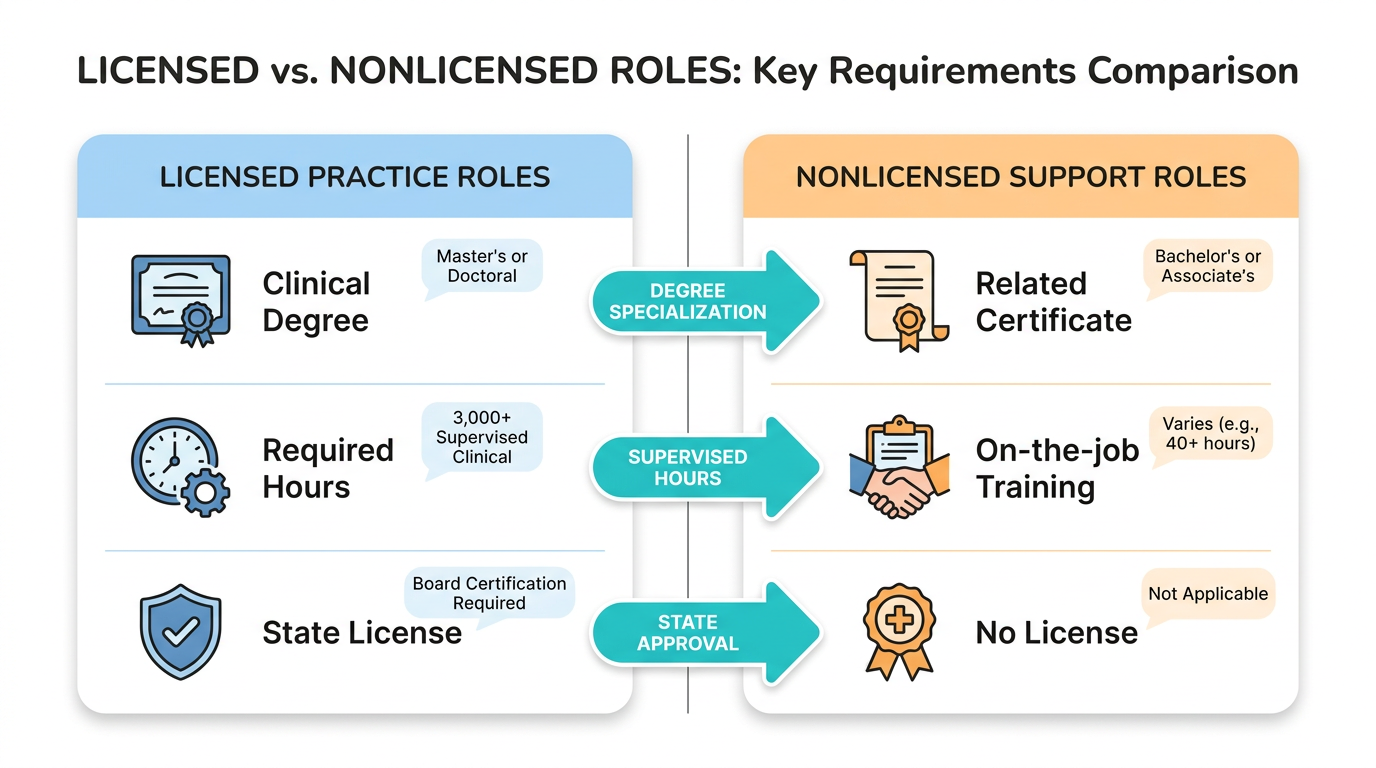
- Not just any master’s in psychology qualifies you for a clinical license. State boards generally want an approved graduate specialization and documented supervised clinical hours, plus a passing score on a licensing exam. A broad psychology degree that skips practicum training or lacks programmatic accreditation may not meet those psychologist licensure requirements at all, even if the school itself is regionally accredited.
- Programmatic accreditation can be the deciding factor. Bodies like CACREP for counseling programs or APA for clinical programs signal that a degree meets the curriculum and supervised hours standards that state boards look for. Understanding the difference between MPCAC and CACREP accreditation explains why this distinction often matters more than institutional accreditation alone when licensure eligibility is on the line.
- Employer expectations shift the picture further. A community mental health center may hire a general psychology master’s graduate into a case management or patient support role, while the same organization fills its licensed therapist positions with CACREP-trained counselors. Nonprofit mental health services and patient support services teams often hire from both pools, but they pay and promote staff very differently depending on credentials.
- Licensure also comes with costs beyond the degree. State exam fees, background checks, supervision fees during post-graduate hours, and liability insurance add up in ways many adult learners do not anticipate. It is worth budgeting for these costs before committing to any program with a clinical track.
1. Clinical Mental Health Counselor Usually Requires Licensure
Of all the jobs a psychology master’s graduate might pursue, a clinical mental health counselor is one of the most clearly regulated. States require a counseling-focused graduate degree and supervised clinical hours, plus passage of a national exam, before someone can practice independently. New York, for example, requires a 60-credit CACREP-accredited program and 3,000 post-degree supervised hours (at least 1,500 in direct client contact), along with passing the NCMHCE exam. Washington State sets a similar bar, requiring 3,000 hours over 36 months with specified minimums for direct client work.
A general psychology master’s can be a rigorous academic credential, but it often does not satisfy those clinical training standards. Programs without a structured clinical practicum or a counseling licensure track may leave graduates academically prepared yet ineligible to sit for the license exam. Students aiming for therapy roles in a community mental health center should check that any program they consider is CACREP-accredited or equivalent and aligned with the specific licensure requirements of the state where they plan to work. Confirm this before enrolling, not after.
2. Marriage and Family Therapist Is a Licensed Path, Not a General Psychology Role
Marriage and family therapy is a licensed profession in all 50 states, and each state sets its own coursework and supervised-experience requirements, along with its own exam standards. The American Association for Marriage and Family Therapy confirms that candidates must meet specific education and supervised experience thresholds before they can practice. A general psychology master’s degree rarely satisfies those standards because the required family systems content is built into MFT-specific programs, not broad psychology curricula.
The gap becomes concrete when you look at state boards. California, for example, requires 3,000 supervised hours over a minimum of 104 weeks, earned only after completing a qualifying degree. Oregon goes further, mandating specific credit-hour minimums by coursework category and a 280-hour direct client practicum within the graduate program itself. If your master’s program does not include those clinical and family systems components, you simply will not be eligible to sit for licensure, regardless of how strong the general psychology content was. A graduate certificate in marriage and family therapy can be a practical bridge for psychology graduates who need that missing coursework, and GetEducated’s guide to COAMFTE-accredited MFT programs is a good starting point for comparing options built around these requirements.
3. Substance Use Counselor Often Requires State Approval, but the Rules Vary
Of all the paths covered here, the substance use counselor field may be the most confusing for adult learners to research, because the credential requirements genuinely differ from state to state. An ASPE/HHS analysis found wide variation in how states license or certify substance use disorder counselors, with significant implications for who can bill independently and who cannot. That variability is the whole problem: a psychology master’s that qualifies you for addiction counseling work in one state may fall short of the requirements in another.
- Check your state licensing board before anything else. A general psychology master’s is not a guaranteed entry point into addiction counseling. The SAMHSA TAP 21 framework outlines specific competency areas that state boards and employers use to evaluate counselor readiness, and those go well beyond a broad psychology background.
- Expect a staged credentialing process, not a single finish line. California, for example, requires counselors to register first and then move toward full certification within five years, with ongoing continuing education required after that. Many states follow a similar pattern of registration followed by supervised practice, then full certification.
- Some nonprofit and community employers will hire you into a supervised role first. This can work in your favor if you are still completing required hours, but advancement, including the ability to practice independently, depends on finishing those credentialing steps. Read more about that pathway in GetEducated’s guide on how to become a substance abuse counselor.
- A dedicated addiction counseling master’s is usually a safer fit than a general psychology degree for students who know this is the career they want. Programs built around this field are more likely to include the supervised clinical hours and curriculum coverage that state boards look for. GetEducated’s list of accredited online substance abuse counseling master’s programs is a practical place to start comparing options.
The bottom line here is the same as it is across every licensed role: the degree has to match the job, not just the general field. If substance use counseling is your goal, comparing addiction counseling programs with your state’s specific requirements side by side is a far better starting point than assuming any psychology master’s will qualify you.
4. Rehabilitation Counselor May Need Licensure for Clinical Work
Rehabilitation counseling sits in a middle ground that catches many students off guard. Some roles center on case coordination and service referrals, which often don’t require a license. But when the work involves direct counseling with clients who have mental health conditions or disabilities, the rules shift. States like Massachusetts have formal statutory requirements for licensure, including defined education requirements and supervised hours, subject to board approval. The job title alone won’t tell you which side of that line you’re on.
Where you plan to work matters as much as what you plan to do. Vocational agencies often hire graduates into coordination roles without a license. Healthcare settings and clinical counseling positions, though, tend to expect licensure or a clear path toward it. Programs built around CACREP accreditation and supervised clinical hours, such as master’s programs in rehabilitation therapies, put graduates in a much stronger position for those clinical roles than a broad behavioral science degree would. The Certified Rehabilitation Counselor (CRC) credential adds professional weight, but it’s not always a substitute for state licensure in clinical settings. GetEducated’s rehabilitation counselor career profile breaks down day-to-day duties and typical education paths for this role.
5. School Psychologist Is Regulated, and a Psychology Master’s Degree Alone Is Often Not Enough
A school psychologist is one of the more tightly regulated roles in K through 12 education, and the credential bar is higher than many adult learners expect. Most states require a specialist-level program, typically around 60 graduate credits, plus a 1,200-hour supervised internship with at least 600 hours completed in a school setting. A standard master’s in psychology, even from an accredited school, usually does not meet those requirements on its own. A graduate certificate in school counseling can help fill that gap for psychology graduates targeting K through 12 settings, and GetEducated’s guide on how to become a school psychologist breaks down what that preparation difference looks like in practice.
The work itself also goes well beyond general psychology knowledge. School psychologists conduct formal psychological assessments, support students with learning and behavioral needs, and work within systems governed by both education department rules and state credentialing standards that vary considerably. If K through 12 practice is your goal, confirm the program’s specialization and practicum structure before you enroll, then verify state approval.
6. Behavioral Health Case Manager Usually Does Not Need Licensure, but It Has a Lower Clinical Ceiling
If you want to work in behavioral health without committing to a full licensure track right away, case management is worth a serious look. The role centers on coordination: connecting clients to services, managing referrals, advocating for care access, and helping people follow through on treatment plans. Because a behavioral health case manager is not providing independent therapy or making clinical diagnoses, most states don’t require a professional license to do this work. Oklahoma’s behavioral health workforce rules, for example, include entry-level case management pathways that require modest education and supervised experience rather than a clinical license. Utah similarly outlines a 400-hour practicum pathway tied to certification rather than licensure.
That accessibility is genuinely useful for adult learners weighing career options against tight schedules and real financial constraints. Here’s what to know before banking on this path:
- Coordination is the core job. Expect to manage referrals, link clients to community resources, and support care plans rather than deliver therapy. The Florida Certification Board’s CBHCM credential outlines these competency domains clearly, including Medicaid billing eligibility, which reflects how employers actually use this role.
- A master’s in psychology can qualify you, but it’s not always required. Some employers hire at this level with a bachelor’s degree and relevant experience, so a graduate degree puts you above the floor rather than at it. GetEducated’s online behavioral science degree guide covers program options that align with these kinds of roles.
- The clinical ceiling is real. Without supervised hours tied to a specific licensure track, this role keeps things moving but stops well short of independent clinical practice.
- It can work as a deliberate first step. For someone building healthcare experience while figuring out whether a longer licensure path fits their life, a case management role offers real exposure to patient support services in a structured setting.
The honest tradeoff is this: behavioral health case management opens a door into healthcare without the credential burden of therapy licensure, but it doesn’t replace that credential if independent clinical practice is the actual goal. GetEducated’s career paths for psychology graduates breaks down which program types are designed to lead toward licensure versus which produce graduates better suited for coordination or support roles. That distinction is worth confirming before you apply: a coordination-focused program will not produce the supervised clinical hours a therapy license requires.
7. Industrial-Organizational Psychologist Usually Does Not Need Licensure
Of all the master’s in psychology jobs covered here, industrial-organizational psychology sits furthest from the licensure conversation. The work centers on workplace behavior, hiring practices, training design, and organizational performance rather than clinical treatment. Because I-O roles operate in business settings rather than healthcare ones, the APA notes that typical I-O positions generally do not require a professional license. The Society for Industrial and Organizational Psychology confirms this, while also pointing out that state rules vary, so it is worth checking your state before assuming no license is needed.
Graduates can also move into a range of related nonlicensed roles: human resources specialist, program evaluator, psychology research assistant, or positions tied to employee assistance programs. Demand across both private and public sectors is strong, and GetEducated’s best buy online master’s programs in psychology and human services list is a solid place to compare options, alongside bachelor’s completion programs in industrial-organizational psychology for those building toward this specialization from an undergraduate track. That said, this path is a poor fit for anyone whose real goal is therapy or direct client care. Choosing an I-O program when you want a counseling career wastes tuition and delays the supervised clinical hours a therapy license requires.
FAQ About Master’s in Psychology Jobs and Licensure
The seven roles covered above raise practical questions that deserve direct answers. Licensure rules are state-specific and tied to program type, so the details matter before you enroll.
Can a general master’s in psychology qualify me for a mental health therapist license?
Usually not. Most states require a counseling-specific degree, not a general psychology master’s, to qualify for a therapy license. The ASPPB licensure guidelines make clear that curriculum alignment with your state’s standards matters as much as the degree level itself.
How do supervised clinical hours affect my eligibility for a counseling license?
They are often the deciding factor. Most state licensing boards set a minimum number of supervised hours before granting a license, and those hours must be completed under an approved supervisor in an approved setting. A program with a built-in practicum is the safest way to stay on track.
Which roles at a community mental health center don’t require a license?
Case managers and intake coordinators often work without a license. These roles focus on coordination and referrals rather than independent therapy. They can be a practical entry point, but moving into clinical practice later will require additional graduate training and supervised experience.
Does an accredited online program still qualify me for licensure?
It can, but accreditation alone is not enough. The program’s curriculum must align with your state board’s specific requirements, covering both coursework standards and practicum hours. Some states require specific accrediting bodies over others, which is why confirming your target program’s accreditation status directly with your state board matters.
What should I compare first before choosing a psychology master’s program?
Start with the job title you want and the licensure rules in your state. Then confirm the program’s specialization matches that credential path and includes practicum access. Employer demand matters too, but none of it helps if the degree doesn’t qualify you for the license the job requires. Browse psychology master’s programs and counseling career guides to compare your options.
Choose the Job First, Then Compare the Degree Path
Florida’s updated LMHC rules make the stakes concrete for master’s in psychology jobs tied to licensure. Starting in July 2025, the state requires a minimum of 60 graduate semester hours and CACREP or MPCAC accreditation, and a general psychology degree, however rigorous, does not qualify. The same logic applies in counseling and substance use work: program type and state requirements determine whether your degree opens the door you want. Academic quality, on its own, does not.
The roles that skip licensure, including behavioral health case management and I-O psychology, are real careers with genuine demand. But they do not lead to independent clinical practice. Knowing that distinction before you enroll is what separates a degree that advances your career from one that delays it. GetEducated’s directory of psychology and human services programs lets you compare accredited online psychology programs by specialization and licensure fit, so your next step is grounded in the job you actually want.