

Key Takeaways:
- Most correctional officer jobs start with a high school diploma or GED, then move through background and fitness screening before employer-run academy training, so checking the actual job posting should come before enrolling in a degree program.
- A criminal justice degree makes sense when it supports a real next step, such as stronger hiring odds and promotion within corrections, or a later move into probation or policing leadership.
- If you do pursue school, start with the lowest-cost accredited option that fits the job requirement, and ask about credit for military service or prior college coursework before you commit.
Most people searching for how to become a correctional officer jump straight to degree programs, but that is usually the wrong starting point. Many facilities hire on a high school diploma and a clean background check, then provide their own academy training, so checking your target employer’s actual job posting comes first. Federal Bureau of Prisons roles and some state promotions are the exception, since they often require college credit alongside a diploma, which is where a criminal justice degree earns its value. GetEducated helps adult learners compare accredited online criminal justice programs so every dollar spent on school serves a real career goal.
Do You Need a Degree or a Diploma?
Whether correctional officer jobs require a degree or just a high school diploma depends almost entirely on who is hiring. Before you spend money on any program, it pays to understand what the actual employer is asking for.
GetEducated's Picks
- East Mississippi Community College Associate of Arts (AA) - Criminal Justice Emphasis
- Michigan State University Master of Science in Law Enforcement Intelligence & Analysis
- Campbellsville University Bachelor of Science in Criminal Justice / Enforcement
Most Jobs Start With a Diploma, Not a Degree
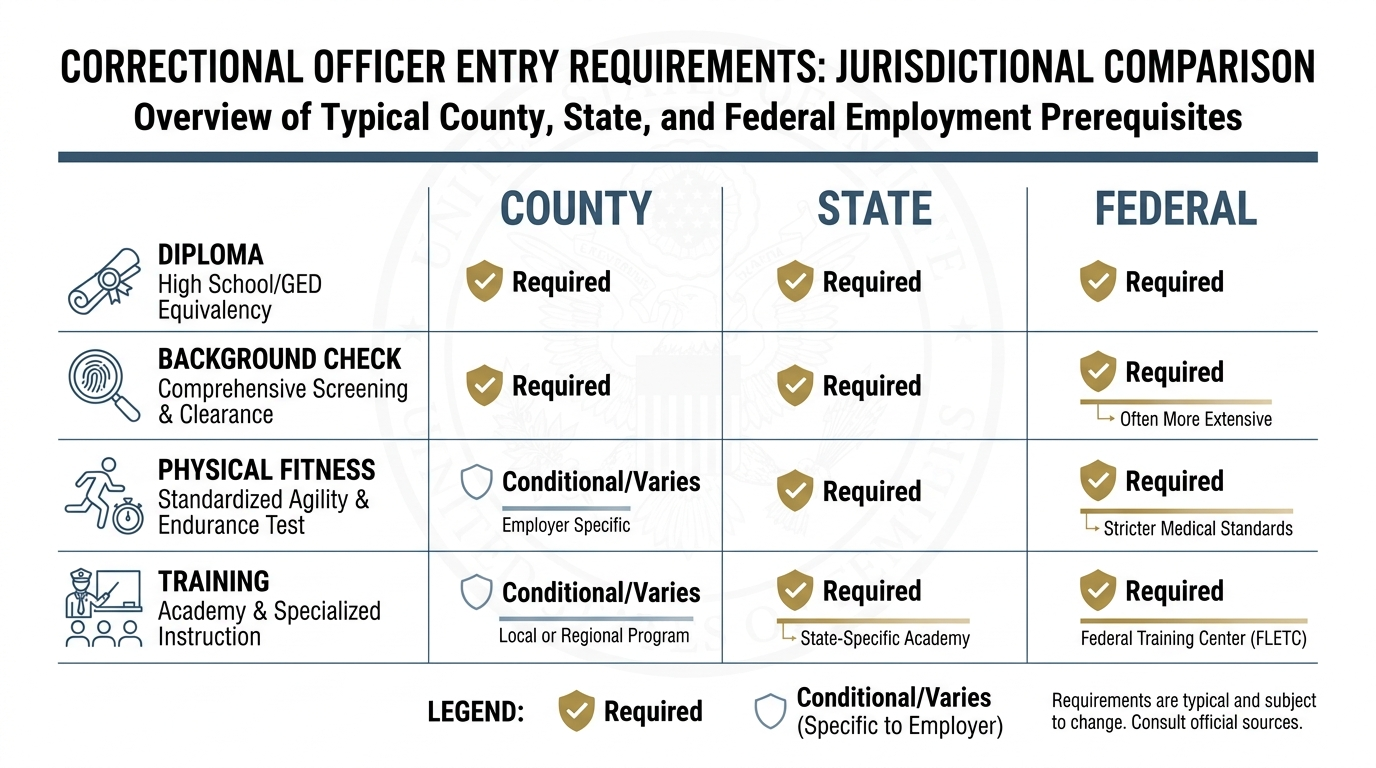
The baseline requirement at most state and local facilities is a high school diploma or GED, combined with age, citizenship, background check, and physical fitness standards. A four-year degree is rarely the ticket through the front door at this level.
Federal and Some State Roles Set the Bar Higher
The Federal Bureau of Prisons sets the highest bar of any corrections employer: entry-level officers generally need a bachelor’s degree in criminal justice or several years of qualifying work experience in counseling, supervision, or a related field. Some state prison systems ask for less, such as an online certificate program in criminal justice, rather than a full four-year degree. County jails and state facilities can vary widely, so the only reliable source is the specific job posting you are targeting.
A Degree Is a Career Strategy, Not an Entry Ticket
Education pays off most clearly when your target role sits above entry-level county corrections. Without a bachelor’s degree or equivalent experience, you are not eligible to apply to the Federal Bureau of Prisons, no matter how many years you have worked in corrections elsewhere. State supervisory ranks reward credentials at promotion time, too. An online master’s degree in criminal justice can expand the range of leadership positions you can apply for, rather than simply improving your odds at a job you are already eligible to pursue. Think of it as a tool for where you want to go, not a box to check to walk through a door you can already open.
 What the Hiring Process and Academy Look Like
The correctional officer hiring process follows a predictable sequence: application, written testing, background and medical screening, a physical fitness assessment, and academy training after hire. Exact requirements shift depending on whether you’re applying to a county jail, a state prison, or a BOP federal facility.
- Submit a complete application with all required documentation upfront, since missing paperwork stalls or disqualifies candidates at many agencies.
- Pass written or aptitude testing early in the process; Arizona’s process, for example, includes a 60-question written exam before a conditional offer is extended.
- Clear background and health screenings, which may include drug testing and a formal psychological evaluation, depending on the employer.
- Meet a physical fitness standard, often a timed, multi-component test that agencies score against specific benchmarks rather than general fitness levels.
- Complete academy training after hire, where coursework covers safety procedures, inmate supervision, use-of-force policy, report writing, and emergency response.
Veterans and career changers who work methodically through the Washington DOC hiring steps tend to move through the process faster. Documentation and physical readiness often carry as much weight as motivation. With the process mapped out, the next question is whether any education will actually improve your odds of getting hired or promoted.
Choose Education That Solves a Real Need
Knowing what education you need to become a correctional officer starts with a simple question: What does your target employer actually ask for? Once you have that answer, you can match your education choice to a real hiring or promotion goal rather than spending money on credentials you may not need.
Start With the Lowest-Cost Option That Works
If the job posting does not require a degree, a short online criminal justice diploma program or one of the most affordable online criminal justice associate degrees can build relevant knowledge without a four-year price tag. These programs are easier to fit around work and family, and they still signal commitment to a hiring panel.
Accreditation Is Non-Negotiable
An accredited program protects you in two ways: your credits can transfer if you decide to continue your education later, and employers treat the credential as legitimate. Unaccredited programs often cost just as much but carry far less weight, and their credits rarely transfer with you.
Veterans and Prior Learners Should Check Transfer Credit First
If you have military training or previous college coursework, along with any relevant work experience, many accredited schools will evaluate that background for credit toward a degree. That credit can shorten your completion time and cut your total cost considerably, so always ask about prior learning assessment before you enroll.
Correctional Officer FAQ
Pay and promotion potential, along with whether a degree is worth the cost, are the top questions most adult learners want answered before committing to this career path. The answers vary more than you might expect, and they almost always depend on where you work and what you want to do next.
How much do correctional officers make, and why does pay vary so much?
According to the BLS Occupational Outlook, federal facilities pay the most, with state prisons and county jails below that. That hierarchy carries a practical implication most salary guides skip: the employers with the highest pay ceilings tend to set the highest education and experience bars to get in. If a federal position or an upper-tier state role is your actual target, the return on a degree is much clearer than it is at the county level. Over time, shift differentials and state cost-of-living differences can push earnings above or below any national figure, so always check the specific posting rather than anchoring to the BLS median.
What are the main advancement opportunities for correctional officers?
Most state departments use a formal promotion ladder. Washington State DOC, for example, moves officers from CO1 to CO2 after one year, per the Washington DOC career ladder, with sergeant and higher supervisory ranks up to captain. Specialized tactical or investigative unit assignments are also available. Correctional experience can also support a later move into probation or a related career path as a police officer or detective.
When does a criminal justice degree make financial sense?
A degree pays off when promotion at your facility requires college credit, or when you plan to move into federal corrections or management. GetEducated’s correctional officer career profile covers this progression in detail. An associate degree often supports entry-level hiring, while an online bachelor’s degree completion program in criminal justice can open supervisory and federal roles with higher pay ceilings.
Compare Your Next Step Before You Enroll
The most useful thing you can do right now, when figuring out how to become a correctional officer for your specific target agency, is pull up the actual job posting and read the requirements line by line. O*NET’s profile for correctional officers and jailers confirms that most positions require only a high school diploma, though federal and specialized roles set a higher bar. State agencies vary just as much. Texas rewards applicants who hold an associate’s or bachelor’s degree with a faster start toward a higher pay grade, which makes the best buy ranking for online bachelor’s programs in justice studies worth checking before you enroll. Oregon, on the other hand, requires only a high school diploma or GED and a minimum age of 21. Your employer’s standards, not a general correctional officer education guide, should drive your enrollment decision.
Once you know what your target facility actually requires, comparing accredited programs is a much more focused exercise. GetEducated’s criminal justice career guides offer side-by-side program comparisons and career pathway data at no cost, so your enrollment decision is grounded in your specific situation rather than a general assumption that more education is always the right move.