

Key Takeaways:
- The right path starts with the job setting you want, since clinical roles call for different training than wellness or fitness roles.
- A bachelor’s degree is the standard entry point for most roles, but employers and certifying bodies care more about core science coursework and supervised hours than the exact major printed on your diploma.
- Choosing an accredited program that matches ACSM certification requirements can save adult learners from losing time and money, especially as CAAHEP-accredited degrees become essential for EP and CEP eligibility in 2027.
Most people assume any health-related degree puts them on the path to becoming an exercise physiologist. Learning how to become an exercise physiologist actually means matching your degree level and clinical hours to the certification you want, not just picking a related major. Get that match right, and you avoid spending years on a program that leads to the wrong door. GetEducated helps adult learners compare accredited online kinesiology and exercise science programs to make that match with confidence, not guesswork.
Where Exercise Physiologists Work
Not all exercise physiology jobs look alike, and the setting you want to work in shapes every education decision that follows. According to O*NET data, the field spans many different settings, each with its own preparation expectations, as the table below shows. Knowing that difference early saves adult learners from enrolling in the wrong degree path.
| Work Setting | Typical Duties | Education Usually Expected | Certification Commonly Preferred |
|---|---|---|---|
| Hospital / Clinical | Exercise stress testing, ECG monitoring, supervised cardiac or pulmonary rehab | Bachelor’s minimum; master’s common for clinical roles | ACSM-CEP or equivalent clinical credential |
| Outpatient Rehabilitation | Monitored exercise prescription for chronic disease or post-injury recovery | Bachelor’s or master’s in exercise physiology or related field | ACSM, NSCA, or setting-specific cert |
| Corporate Wellness | Fitness assessments, health coaching, wellness programme coordination | Bachelor’s in exercise science, kinesiology, or health promotion | ACSM-EP, NSCA-CPT, or similar |
| Community Health | Group programming, health education, population-level fitness initiatives | Bachelor’s; some roles accept associate-level entry | Varies by employer |
| Fitness Facility / Sports Performance | Strength and conditioning, performance testing, individual training | Bachelor’s preferred; some roles accept certificate-level credentials | NSCA-CPT, CSCS, or ACE |
| Research / Academia | Lab-based testing, data collection, programme evaluation | Master’s or doctorate typically required | Field-specific; varies by institution |
According to the American Society of Exercise Physiologists, clinical settings involve activities like VO2 max testing and ECG monitoring, where higher-risk diagnostics require physician oversight. That boundary matters for your degree choice: in clinical and hospital environments, employers and certification bodies are scrutinizing the depth of your science preparation, not just the credentials on your wall.
The ACSM notes that CEP-certified physiologists in hospital and rehabilitation settings tend to earn more than peers in community or fitness-based roles, but only in settings that actually reward that level of preparation. A community wellness coordinator role calls for a different, often less expensive degree path than cardiac rehab does. Knowing your target setting before you compare programs is what prevents you from buying a degree for a career you will never enter. You can explore how degree levels map to these settings through GetEducated’s exercise physiology and kinesiology degree guide.
What Degree Do You Need?
What degree do you need to become an exercise physiologist? For most positions, a bachelor’s degree in exercise science or kinesiology is the expected minimum. The right level depends on where you want to work and which certification you plan to earn.
GetEducated's Picks
- Concordia University, St. Paul Bachelor of Arts in Exercise Science
- East Central University Bachelor of Science in Kinesiology
- Eastern Oregon University Bachelor of Arts / Bachelor of Science in Health & Human Performance
A Bachelor’s Degree Is the Standard Starting Point
For clinical or medically supervised settings, a bachelor’s degree in exercise science or kinesiology meets the threshold that both employers and certification bodies set. The Bureau of Labor Statistics confirms this, and the field is projected to grow 9% between 2024 and 2034. The ACSM Exercise Physiologist credential also lists a bachelor’s in exercise science or a related field as the minimum for eligibility.
Your Major Matters Less Than Your Coursework
The specific degree title on your diploma is less important than what you studied. Certification bodies and employers want to see solid preparation in anatomy and exercise-testing coursework. A 2024 analysis of 615 U.S. job postings found that a bachelor’s degree was the predominant minimum requirement across exercise-related roles, with no single major dominating. If your program covers the core science content, you are in a strong position regardless of whether it is titled exercise physiology or exercise science.
When a Master’s Degree Makes Sense
Some hospital-based or research-adjacent roles prefer or require a master’s in exercise science. Before adding years and tuition to your plan, check the actual job postings in your target setting. It is also worth knowing that the ACSM-CEP credential accepts either a master’s with 600 supervised clinical hours or a bachelor’s with 1,200 hours, which means the degree level and the clinical hour commitment trade off directly against each other. If the roles you want list a bachelor’s as sufficient, starting there and accumulating clinical hours is often the lower-cost path to the same credential.
Choose an Accredited Online Program
Not every online exercise physiology program will prepare you equally for the career you have in mind. Before you compare tuition rates or course schedules, the first question to settle is whether a program holds the right accreditation. That single detail shapes whether employers take your degree seriously and whether you qualify for professional certification. It can also affect whether credits transfer if you continue your education later.
For exercise physiology specifically, CAAHEP (the Commission on Accreditation of Allied Health Education Programs) is the programmatic accreditor. You can verify whether a program holds that standing through CAAHEP’s accredited program directory before you fill out a single application. Regional institutional accreditation also matters, but programmatic accreditation tells you the curriculum has been reviewed against professional standards, not just general academic ones.
Once accreditation is confirmed, the next layer is certification alignment. The ACSM Certified Clinical Exercise Physiologist credential requires documented clinical hours at both degree levels, and not every program makes it easy to see how their supervised practicum requirements help you meet that threshold. Map a program’s requirements against certification prerequisites before tuition ever enters the conversation.
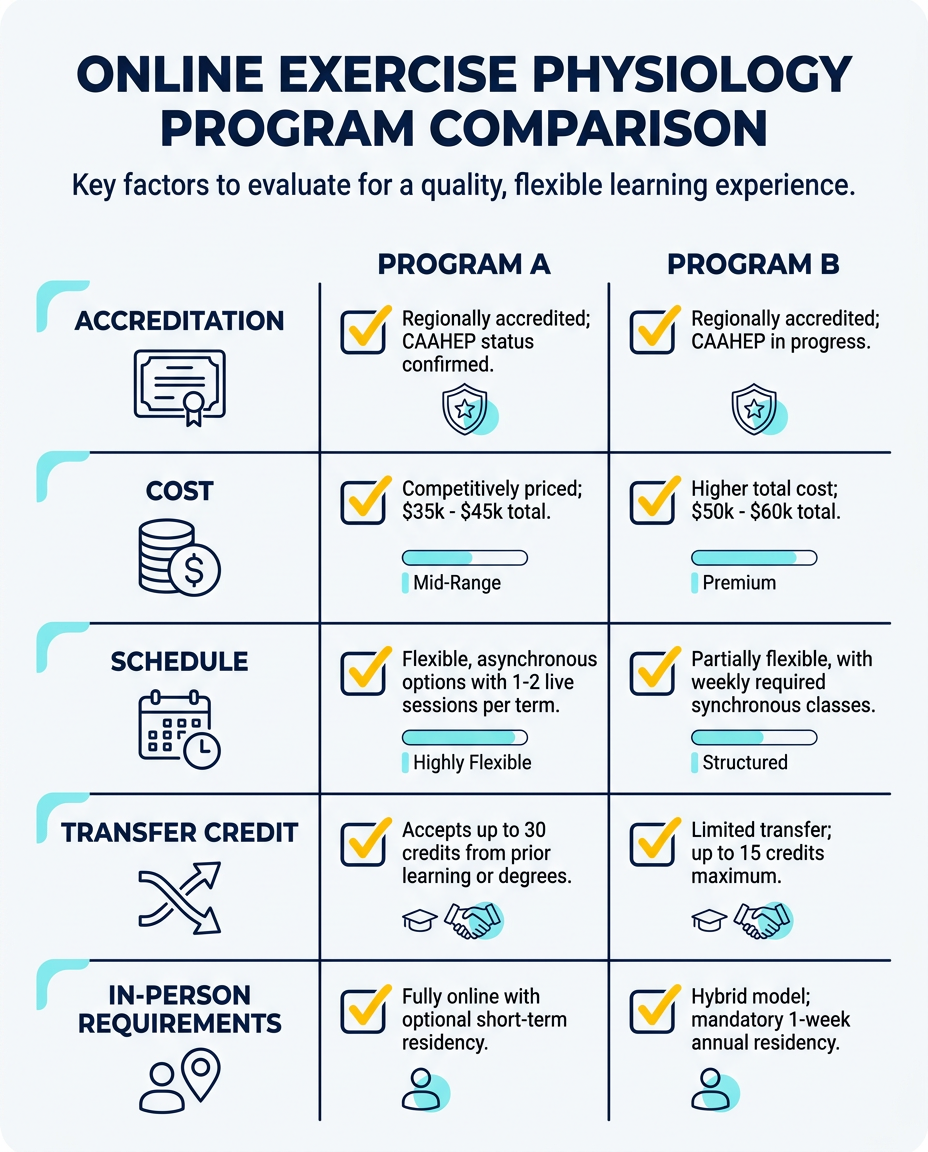
Here is what to compare across accredited online options:
- Confirm accreditation status first. Check both institutional accreditation and CAAHEP programmatic accreditation using the official directory, as a program missing either may limit your access to certification exams or graduate school admission.
- Match the curriculum to certification content. Review whether the program’s coursework aligns with the exam content outline for the certification you plan to pursue, because gaps in anatomy or exercise-testing preparation will show up when it counts.
- Ask specifically about clinical or in-person requirements. Many online programs still require on-site practicum hours or lab intensives. Knowing where and when these requirements happen prevents surprises that can derail a working parent’s timeline.
- Review transfer credit policies before applying. If you have prior college credits, a program with generous and transparent transfer policies can meaningfully shorten your time to completion and reduce your total cost, so request a credit evaluation early.
- Compare total cost, not just tuition per credit. Factor in required fees and materials. Also account for travel costs tied to any in-person components and the total time the program will take to finish.
- Look for flexibility that is genuinely documented. Asynchronous coursework (classes you complete on your own schedule rather than at a set time) is only useful if the program spells out exactly when clinical placements are required and how they can be arranged around a work schedule.
For adult learners balancing a job and family, an online program is a practical choice, but flexibility has to be paired with transparency. A program that buries its in-person requirements in the fine print can cost you far more in lost time than a slightly higher tuition rate at a program that is upfront. GetEducated’s online kinesiology and exercise science resources include program-level details across degree levels, so you can screen for the factors that matter most to your situation before committing.
Exercise Physiologist: Frequently Asked Questions (FAQs)
The questions below address what adult learners most often ask before committing to a program.
Which certifications are required or preferred for exercise physiologists?
The two most widely recognised credentials are the ACSM Certified Exercise Physiologist (ACSM-EP) and the ACSM Clinical Exercise Physiologist (ACSM-CEP). Clinical roles in hospitals or cardiac rehab typically expect the CEP. Employers increasingly treat certification as a standard expectation, not just a bonus credential.
Can you become an exercise physiologist with an online degree?
Yes, but the program must be regionally accredited and cover the science coursework that certification bodies require. Many programs on GetEducated’s kinesiology bachelor’s degree rankings are built with those prerequisites in mind. The degree format matters less than whether the curriculum meets the eligibility standards for the credential you plan to pursue.
Do you need clinical or hands-on training before applying for jobs?
Most degree programs include a practicum or internship component, and the ACSM-CEP requires documented clinical hours as part of the application. Even for roles that do not mandate the CEP, supervised experience makes candidates more competitive. Before you enroll, confirm that your program arranges or supports those placements, since online students sometimes need to locate their own clinical site.
How long does it take to become an exercise physiologist?
A bachelor’s degree typically takes four years full-time, though adult learners with transfer credit can shorten that timeline. Some programs on GetEducated’s kinesiology master’s program rankings run 18 to 24 months. The right pace depends on your target work setting and whether the roles you want reward or require graduate-level preparation.
Does the school’s accreditation really affect your career?
Accreditation directly affects whether employers consider your application and whether certification bodies accept your degree as eligible. Employers in clinical and hospital settings screen for degrees from accredited institutions. Certification bodies like ACSM tie eligibility to degree requirements that assume proper accreditation. Choosing an unaccredited program to save money upfront can block your path to the certification that makes you hireable in the settings where exercise physiologists earn the most.
Compare Degrees Before You Commit
Starting from August 2027, the ACSM requires all EP and CEP candidates to hold a degree from a CAAHEP-accredited program. That is not a distant policy change. Anyone enrolling today in a bachelor’s or master’s program that runs two to four years is already inside that window. A degree from a non-CAAHEP program will not make you eligible for the credentials that clinical and hospital employers expect, regardless of your grades or clinical hours. The right program matches your target setting and the certification you plan to earn, while holding the accreditation that keeps your options open.
Spending time comparing programs by cost and format protects you from starting over later. GetEducated gives you transparent, independent tools to search and compare more than 35,000 accredited online degrees from over 1,700 schools, all in one place. Browse accredited online health and exercise science degrees and filter results by level and cost to find the program that fits your life, so you know exactly how to become an exercise physiologist without wasting time or money.