

Key Takeaways:
- STEM majors such as computer science, information technology, cybersecurity, data science, health informatics, engineering technology, and mathematics offer strong career growth, high salaries, and flexible pathways ideal for adult learners.
- Choosing an accredited online STEM program is crucial for eligibility for federal financial aid, transfer credit acceptance, and employer recognition, factors that protect your investment and support career advancement.
- Adult learners should prioritize programs that offer flexible scheduling, robust student support, and opportunities for industry certifications to balance education with work and family responsibilities.
Choosing the right STEM major is one of the most consequential decisions an adult learner can make. For those balancing work and family, the best STEM majors are not just about earning potential. They are about finding a degree that fits your life and career goals.
Seven STEM fields consistently show strong employer demand and well-defined pathways for career changers. GetEducated offers a free comparison tool to help you search and compare accredited online STEM programs to match your budget and schedule.
What Makes the Best STEM Majors for Adult Learners?
The best STEM majors for adult learners do more than promise high salaries. STEM occupations grow faster and pay more than non-STEM roles on average, according to BLS data. The strongest choices prepare you for several job titles across more than one industry, which matters when you are juggling work and family responsibilities.
GetEducated's Picks
- Grand Canyon University Bachelor of Science in Elementary Education / STEM
- University of West Alabama Bachelor of Science in General Science / Teacher Certification
- Grand Canyon University Bachelor of Science in Mathematics for Secondary Education
Choosing the right major is only part of the decision, because program quality matters just as much. Only programs from accredited institutions qualify for federal financial aid, which means verifying accreditation before enrolling protects both your time and your money. Your transfer credits also deserve a close look, since prior college credits can shorten time to graduation. A program that is upfront about costs and credit policies makes the road to your degree much more predictable.
Flexibility is equally worth evaluating when comparing programs. If you are working full-time or raising a family, you need coursework that fits around your schedule. Online STEM programs that let you complete assignments on your own schedule give you far more control over your time. Look for programs that also offer academic advising and responsive student support, because those resources make a real difference when life gets busy.
Computer Science: A Versatile Choice for High-Growth Tech Roles
Computer science stands out among STEM majors for the range of career paths it supports. Graduates work in software development, cloud computing, web development, and automation across nearly every industry. According to BLS data, computer and IT occupations are projected to grow much faster than the national average through 2034. For adult learners who want skills that stay relevant across employers and industries, that growth trajectory matters.
For self-directed adult learners, an online computer science degree builds skills that carry across roles and industries. Software developers, one common career path for CS graduates, earn a median annual wage of over $130,000, according to BLS salary data. If math and structured problem-solving are not areas you enjoy, it is worth considering that before committing to this path. GetEducated lists over 300 accredited online CS programs if you want to see what options currently look like.
Information Technology: A Practical Path Into Tech for Career Changers
Information technology tends to be more hands-on than computer science, making it a practical fit for adults who want real-world tech skills without a heavily theory-driven curriculum.
The Bureau of Labor Statistics projects IT occupations to grow much faster than average, with median wages well above the national average, making an online information technology degree a strong option for career changers.
- Focuses on applied skills in networking and systems administration, with coursework tied directly to workplace tools and environments.
- Prepares graduates for roles like network administrator and systems analyst, positions employers across industries consistently need to fill.
- Pairs naturally with certifications like CompTIA A+ or CompTIA Network+, which can strengthen your resume while still in school.
- An IT associate degree qualifies graduates for computer support specialist roles, giving adults a faster entry point into the field.
IT is one of the more accessible fields to enter through an online degree. GetEducated’s list of accredited online IT degree programs is a good place to compare options by cost and format before choosing the right program.
Cybersecurity: A Strong Major for Stability and Skills-Based Hiring
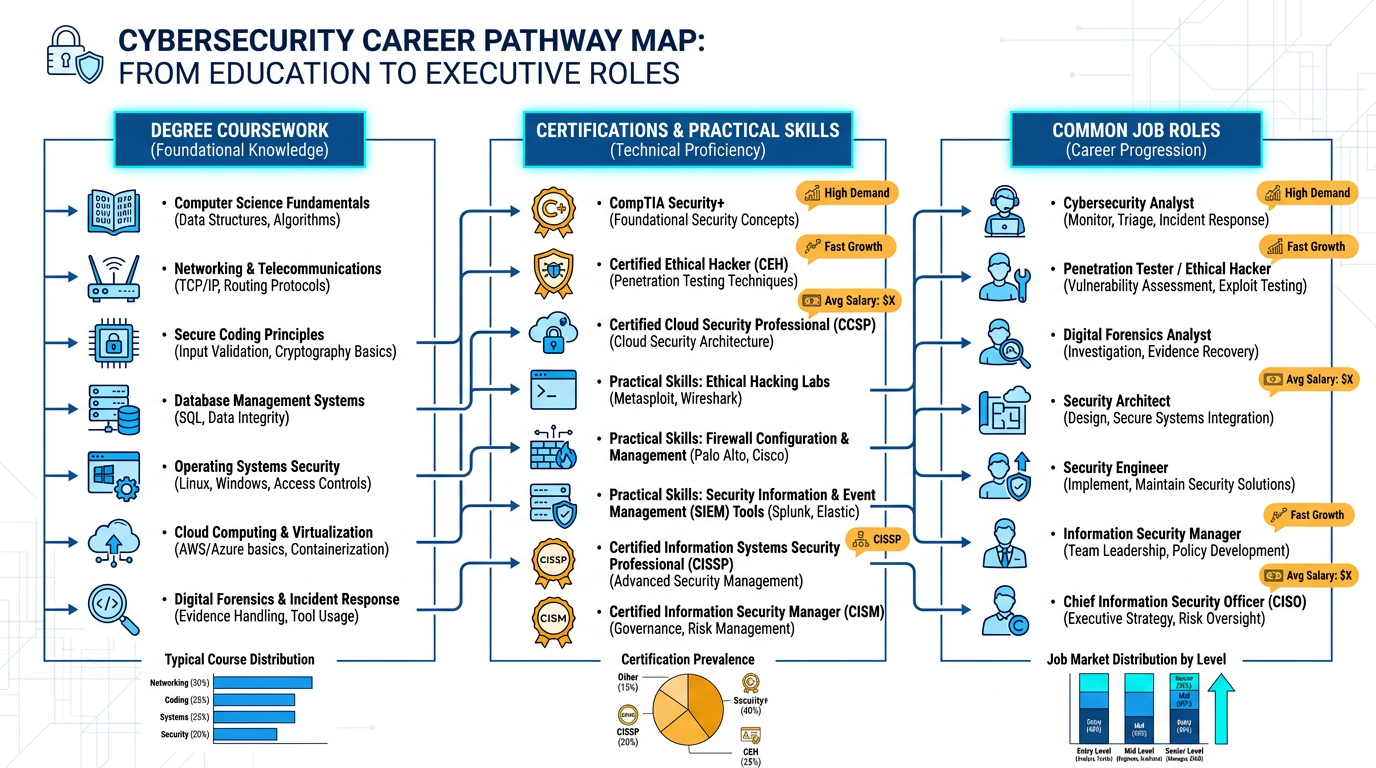
Cybersecurity is one of the fastest-growing fields in tech, with the BLS projecting 29% job growth for information security analysts through 2033 and a median annual salary of $124,910 in 2024.
For adult learners, the appeal comes down to how directly cybersecurity connects to skills-based hiring. Many online cybersecurity degree programs support certification prep alongside coursework, and cybersecurity certificates can give you credentials to show employers sooner.
- The BLS reports roughly 16,000 new information security analyst openings each year, pointing to steady demand for qualified candidates.
- Certifications earned alongside an online cybersecurity degree strengthen your qualifications and can make you more competitive before graduation.
- The NICE Framework maps cybersecurity roles to specific competencies, helping programs build coursework around what employers actually need.
- CISA’s career resources outline apprenticeship-friendly pathways and scholarship opportunities for adults entering the cybersecurity field.
- Cybersecurity threats and tools evolve quickly, making this field a strong fit for learners who enjoy continuous problem-solving.
GetEducated’s ranking of top online cybersecurity programs can help you compare accredited options side by side before committing to a school. If you prefer working with data over systems and networks, data science offers a different kind of analytical career path.
Data Science: A High-Upside Option for Analytical Thinkers
Data science sits at the intersection of statistics and business strategy, which is what makes it stand out from other tech-adjacent STEM majors. Industries from healthcare to finance actively hire data scientists because nearly every sector now runs on data-driven decisions. According to the Bureau of Labor Statistics, employment for data scientists is projected to grow 36% through 2033, with a median annual salary of $108,020.
An online data science degree works best for adults who genuinely enjoy working with numbers and structured problem-solving. Coursework leans heavily on statistics and data modeling, with programming woven throughout, and the workload can be demanding. If math is not your strong suit, this major will feel like a stretch. Being honest with yourself about that fit before enrolling can save you real time and money. GetEducated’s guide on becoming a data scientist gives you a realistic picture of what this career involves and what degree options are worth considering.
Health Informatics: A Smart STEM Major for Adults Interested in Healthcare
Health informatics is where healthcare meets data management and digital tools. People in this field help improve patient care outcomes by managing health data systems without needing a clinical license. According to BLS projections, health information roles are expected to grow 15% from 2024 to 2034, well above the national average. The national health IT priorities tracked by the ONC show continued growth in electronic health record adoption across the country.
For career changers, an online health informatics degree offers a realistic path into healthcare without a clinical background. Programs range from certificates to master’s degrees, which means you can start at a level that matches your experience. When comparing options, look for CAHIIM accreditation, a recognized quality standard for the field. If you’re not ready for a full degree, certificate programs in health informatics can be a practical starting point while you build credentials.
Engineering Technology: A Hands-On Major With Applied Career Paths
For adults with hands-on experience in operations or production, an engineering technology (ET) degree online may suit your background better than a traditional engineering program, with coursework focused on applied systems rather than abstract theory.
BLS engineering technology data shows that ET graduates often find work in industrial systems and technical roles, with competitive wages and solid full-time employment rates. Here is what to know before choosing a program.- Engineering technologist job outlook shows quality control and manufacturing operations as the top career destinations with steady demand.
- Hands-on work history in trades or technical roles often carries over into ET coursework and job duties.
- Look for programs with ABET accreditation, which signals recognized standards for applied engineering education.
- Online engineering technology programs at the associate and bachelor’s level include accredited options designed around working adult schedules.
- ET graduates with operational backgrounds can apply existing skills directly toward supervisory or technical management roles.
For adults with a background in hands-on technical work, an engineering technology degree offers a practical path to career advancement that builds on what you already bring to the job.
Mathematics: A Flexible Foundation for Many Quantitative Careers
A mathematics degree for careers opens doors in finance, analytics, education, and technology, even if it doesn’t point to one specific job title. Math graduates develop analytical and problem-solving skills that employers consistently rank as top hiring priorities, according to a recent NACE survey. The Bureau of Labor Statistics reports that mathematicians and statisticians earn a median annual wage of about $99,960, with job growth projected at 31% between 2022 and 2032.
That earning potential grows even further when you pair an online math degree with applied electives or a certificate in statistics or data analysis. A graduate who adds a data analysis certificate, for example, can pursue roles in business intelligence or financial modeling. If you enjoy working with numbers and structured problem-solving, a math degree can pay off across multiple industries over time. You can explore 16 career paths for math majors to find the direction that fits your goals.
FAQ About the Best STEM Majors for Career Changers
Choosing among the best STEM majors for career changers comes with real, practical questions. Whether you are thinking about your math background or how employers view online credentials, having clear answers makes the decision easier.
Which STEM major works best for adults with a full schedule?
Information technology and health informatics are among the most accessible and realistic options for adults exploring the best STEM majors for career changers. Both fields are well represented among accredited online IT degree programs and do not require as much programming or abstract theory as computer science. Your career goals should still guide the final choice, since workload varies by school.
Do I need strong math skills to pursue a STEM degree?
It depends on the major. Fields like information technology and health informatics require less advanced math than data science or engineering technology. If math has been a barrier in the past, an IT or health informatics program offers a more manageable path into an online degree program.
Are accredited online STEM degrees respected by employers?
Yes, and that acceptance has grown since the pandemic. VCU research published in 2026 found that employer attitudes toward online degrees improved markedly. UIC Online reports similar findings, and both sources identify accreditation as the most important factor employers look for in an online STEM degree.
What should I look for if I have transfer credits or limited study time?
Look for programs that accept transfer credits and offer asynchronous coursework, where you complete lessons on your own schedule, not at fixed class times. Check how many total credits the degree requires and how many transfer credits the school will accept.
Should I pursue certifications alongside my STEM degree?
For fields like cybersecurity and IT, certifications can strengthen your resume before you graduate. Recent research shows that employers increasingly value demonstrable skills alongside a degree. Pairing your coursework with industry certifications is a practical way to stand out during a career change.
Compare Top Online STEM Degrees and Choose the Right Fit
STEM occupations are expected to grow faster than non-STEM roles through 2034. The College Scorecard lets you check earnings and graduation outcomes by field of study before you choose a program.
Once you have a sense of what a field pays, comparing the best STEM majors means looking beyond rankings. It is worth focusing on tuition costs and transfer credit policies. National Center for Education Statistics data shows millions now study fully online, and regionally accredited programs are widely accepted by employers.
GetEducated lets you search and compare more than 35,000 online programs to find the STEM degree that works for your life and your budget.