

Key Takeaways:
- You can complete much of your radiology tech coursework online, but ARRT-required clinical training must happen in person with real patients and documented supervision.
- JRCERT accreditation is the checkpoint that protects your time and money, because it affects whether your clinical hours qualify for certification and state licensure.
- The smarter way to compare programs is to check state licensing fit, clinical placement details, published pass rates, and schedule realism before you look at tuition alone.
Most searches for how to become a radiology tech return results heavy on online programs. That framing is accurate, but incomplete in a way that catches adult learners off guard, since national certification also requires supervised, in-person clinical training on real patients before your state layers on its own licensing rules. Online coursework covers the theory, but clinical hours are a fixed requirement that no format change removes.
GetEducated can help you compare accredited online radiologic technology programs that address both components of this path.
Follow the Real Steps, From Online Classes to Clinical Hours
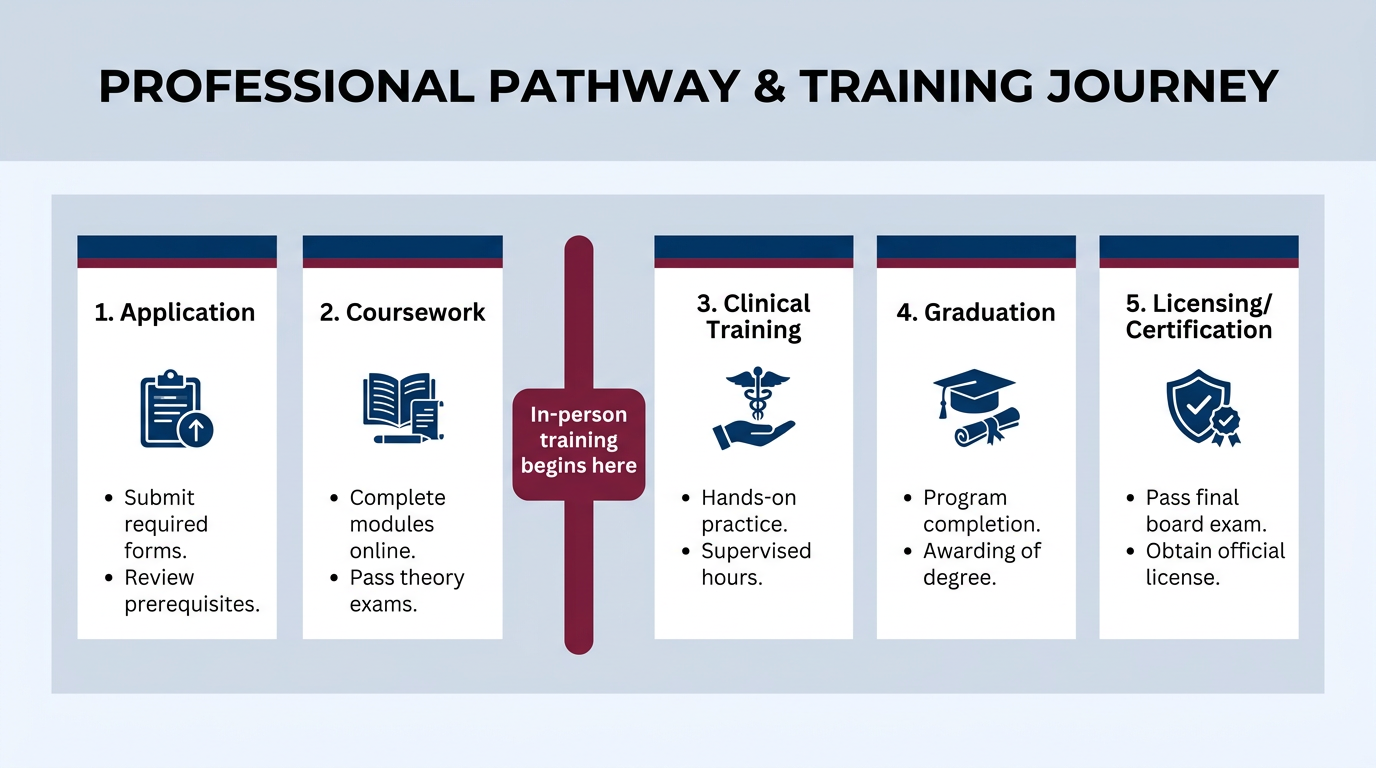
Many adult learners wonder: can you become a radiology tech online, or are in-person clinical hours required? The answer is both. The path has a fixed sequence, and understanding where flexibility exists and where it does not saves you from costly surprises.
GetEducated's Picks
- East Mississippi Community College Associate of Arts (AA) - Medical Technology Emphasis
- La Roche University Bachelor of Arts in Medical Imaging
- Loma Linda University Master of Science in Radiologist Assistant
Start With an Accredited Program
Every credible path begins with enrolling in a JRCERT-accredited radiography certificate program. Accreditation determines whether your clinical hours count toward national certification and state licensure.
Online Coursework Covers the Theory
Anatomy, patient care, radiation physics, and imaging procedures can all be taught through online or hybrid formats. This is where programs can genuinely flex around a work and family schedule. That flexibility, though, only applies to the classroom side of your training.
Clinical Hours Must Happen in Person
The ARRT requires that clinical competencies be performed on actual patients and verified by a program director. No simulation or video substitutes for this. States like California also formally approve clinical training sites, adding another layer of regulatory oversight that programs must satisfy.
The Decision That Actually Matters
Choosing between “online” and “campus” is the wrong frame. The real question is whether a program can show you exactly how its clinical placement and coursework demands fit a working adult’s schedule, with specifics, not a marketing timeline.
 Check Whether Accredited Programs Include the Clinical Training You Need
Not all radiologic technology programs are built the same, and the difference often shows up in the clinical training details. When adult learners ask what accredited radiologic technology programs include for required clinical training, the honest answer is: a good program tells you upfront. A vague answer about clinical placement is itself a red flag worth taking seriously before you spend tuition money.
JRCERT accreditation standards set a clear baseline. Programs must use JRCERT-recognized clinical sites, maintain a 1:1 student-to-staff ratio during certain procedures, cap clinical shifts at 10 hours per day, and publish five-year pass and job-placement rates. These aren’t just administrative details. They tell you whether the program has real infrastructure behind its clinical component or whether placement logistics are an afterthought. ARRT also publishes specific didactic and clinical competency requirements that programs must cover for you to sit for the national exam, and those requirements are being updated effective March 2027, so programs you compare today should already be preparing for that change.Here are the practical questions to ask before you commit:
- Confirm the program holds JRCERT accreditation. Without it, your clinical hours may not qualify toward national certification or state licensure, no matter how many you complete.
- Ask where clinical placements are located and how they are arranged. Some programs coordinate sites for you; others expect you to find your own. For working parents, the distance and scheduling of a clinical site can make or break a program’s fit.
- Check what prerequisites clinical admission requires. Background checks and immunization records are standard prerequisites at most sites, and most also require current CPR certification, as outlined on GetEducated’s diploma-level radiology training options. Missing one can delay your start date by a semester.
- Look up the program’s published pass and placement rates. JRCERT standards require programs to meet a 75% benchmark on both. A program that buries or omits this data is worth questioning.
- Compare total cost alongside clinical logistics. A lower tuition figure means less if the clinical site requires you to stop working during placement. Factor in the schedule format and transfer credit policies first, then confirm whether the program’s timeline is realistic for your life, not just what its marketing page says.
If a program you are considering cannot give you straight answers on site locations and supervision structure, or it withholds its published outcomes, that is the information you need. Programs with strong clinical infrastructure are transparent about it because it is one of their genuine advantages.
For a broader look at how programs compare, GetEducated’s bachelor-completion radiology listings offer a useful starting point for credential holders looking at next-step options.
Radiology Tech FAQ: Licensing, Certification, and Online Study
Licensing rules and program formats raise questions that most school websites do not answer clearly up front. Getting these answers before you enroll protects your time and career goals.
Do you need a license or certification to work as a radiology tech in your state?
Most states require both. ARRT certification is nationally recognized and widely required by employers, but it is separate from state licensure. States set their own rules, and some, like Florida, require passing a state-administered exam and completing an accredited program before you can practice. Always check your state’s specific rules before enrolling.
Can you become a radiology tech fully online, or do employers and states expect in-person clinical training?
You cannot complete this credential entirely online. Didactic coursework can be delivered online, which helps working adults manage their schedule, and it typically covers anatomy and imaging theory. Patient care fundamentals are folded into that same online or hybrid coursework. Supervised clinical hours with real patients, verified by your program, are non-negotiable. Employers and state licensing boards both expect that hands-on training be documented and accredited.
What accreditation should a radiology tech program have?
Look for JRCERT accreditation, which stands for the Joint Review Committee on Education in Radiologic Technology. Programs without it may not qualify you for ARRT certification or state licensure. Skipping this check is one of the most expensive mistakes adult learners make when comparing programs on cost or schedule alone.
What should you ask a school before enrolling in an online or hybrid program?
Ask two questions upfront: where your clinical placement will be located and how the school helps you arrange it. Then confirm whether the program’s graduation timeline is realistic for someone working full-time. A school that cannot answer these questions clearly is a program worth skipping. Browse a radiologic technology program directory with these questions as your filter, and you will spend your time on the options genuinely worth pursuing.
Use Trusted Career Guides Before You Compare Programs
The BLS reports a median annual wage of $77,660 for radiologic technologists and technicians, with job growth projected through 2034. That figure is genuinely within reach for adult learners who complete a JRCERT-accredited program and meet both ARRT certification and state licensing requirements. It is not within reach for someone who spent two years in a program that could not document their clinical hours or failed to satisfy state approval. The difference between those two outcomes comes down to the program comparison you do before you enroll. Related allied health roles, such as health information technician positions, follow a similar pattern: the credential only pays off when the program behind it is properly accredited.
The smartest move before you compare tuition costs or schedules for how to become a radiology tech is to get clear on what employers and licensing boards actually expect. GetEducated is built for adult learners who want straightforward, unbiased information on accredited pathways, including radiologic technology program rankings that show how programs stack up on cost and outcomes. If your interests extend beyond direct patient imaging, healthcare management careers are also worth a look once you have clinical experience under your belt. Start there to map the requirements to your state, then compare your options with confidence.