

Key Takeaways:
- There’s no single degree path for database administration. Choose one that fits your background and budget, with a curriculum that covers the technical foundations you need.
- Prioritize accreditation because it shapes your financial aid eligibility and whether your prior or military credits will transfer.
- Certifications are most valuable after you’ve built core skills in SQL and database design across at least one major platform.
Figuring out how to become a database administrator is easier when you know what actually drives hiring decisions. The difference between candidates rarely comes down to school reputation; it comes down to whether their program built real SQL fluency and database design skills.
Whether you are starting from scratch or building on military IT experience and prior credits, there is an accredited path that fits your timeline and budget. GetEducated helps adult learners browse and compare online computer information systems degrees by cost and program depth, so you can choose with confidence.
Pick the Education Route That Fits Your Background
How to become a database administrator looks different depending on where you’re starting from. A veteran with hands-on IT experience needs a different plan than someone switching careers from an unrelated field. Multiple education routes can lead to the same destination, but the right one depends on what you already bring to the table.
Your Starting Point Changes the Calculation
Someone with military IT experience can often enter a database program at a higher level, with transfer credit already in hand. An entry-level learner benefits from building a broad IT foundation first. Matching the route to your background prevents paying for coursework you’ve already mastered in the field.
Any Degree Level Can Work When the Curriculum Is Right
The Bureau of Labor Statistics reports that most database administrators hold a bachelor’s degree, though related IT backgrounds can also open the door. An accredited associate degree in IT or computer science is a practical, lower-cost starting point when the program teaches SQL and database design fundamentals. A bachelor’s in information systems or computer science typically broadens your options, especially for specialized or senior-level roles.
Accreditation Is the First Filter to Apply
Before comparing tuition or program length, confirm that a school holds recognized accreditation. This shapes whether your credits transfer and whether employers will recognize the credential you earn. The Higher Learning Commission requires accredited schools to publish clear transfer credit policies. That means you can verify before enrolling whether prior learning or military coursework will count toward your degree. GetEducated’s accreditation guide walks you through exactly what to look for and how to check a school’s status.
Learn the Skills and First Certifications That Matter
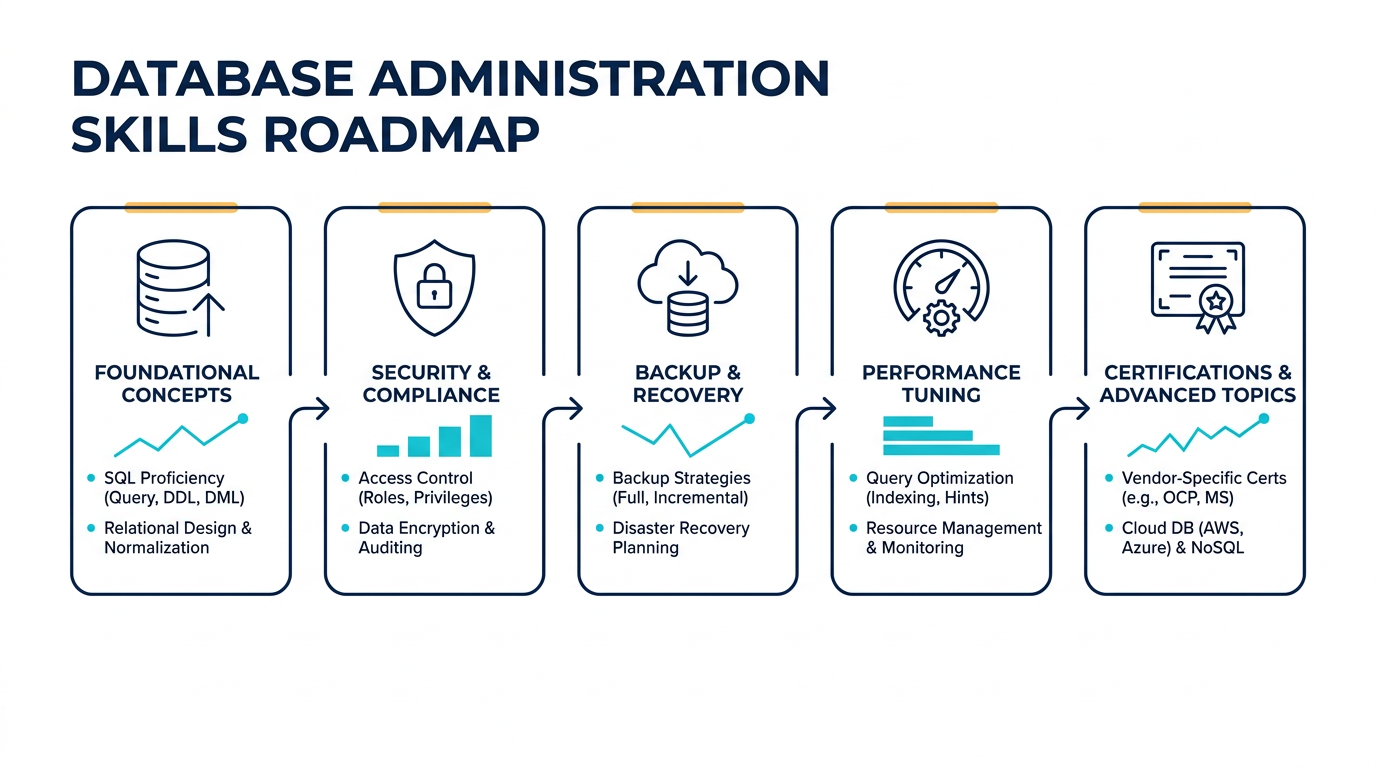
Asking what technical skills and tools you should learn for a database administrator role produces consistent answers across job postings and labor data. According to BLS labor data, the work centers on keeping databases secure and available, which is why the skills that get you hired are the ones you can demonstrate on the job, not just describe. O*NET labor data and employer postings consistently point to the same starting priorities:
- Write and use SQL confidently. Structured Query Language is the core tool of the trade. Most database tasks, from pulling reports to adjusting data permissions, run through SQL, and employers expect you to have working fluency before you specialize.
- Learn database design and administration fundamentals. Understanding how to structure a database and manage user access and permissions prepares you for the real responsibilities of the role.
- Practice backup and recovery alongside performance monitoring. These are the skills that protect organizations when something goes wrong. Knowing how to restore data and spot performance problems early is what separates a prepared candidate from one who has only studied concepts.
- Get familiar with at least one major relational database platform. Microsoft SQL Server and Oracle appear most often in job postings; picking one to learn in depth gives you practical experience that transfers across employers.
- Start building cloud database awareness. Cloud-based database environments have become a standard part of many IT roles. Computer information systems programs increasingly include these concepts, and they show up in job descriptions more often each year.
On certifications: a platform-specific credential like the Microsoft Certified Azure Database Administrator Associate can strengthen your profile, but it works best after you have database coursework or real work exposure behind you. A certification signals focus and platform knowledge. It does not replace the foundational IT and database training that gives you something to apply on the job. Think of early certifications as a way to confirm and communicate the skills you have already built, not as a shortcut around building them.
 FAQs: Common Questions About Becoming a Database Administrator
Choosing how to enter database administration raises a lot of practical questions, especially for adult learners who have prior military service or IT experience and want to put those credentials to work. The answers below address what really matters when you are weighing your options.
Can military experience or prior learning help you become a database administrator faster?
Yes, and often more than people expect. The ACE Military Guide translates military training into college credit recommendations, and over 2,500 institutions accept those recommendations. You can request your Joint Services Transcript through the VA, then submit it to any school you are considering. GetEducated’s guide on prior learning credit explains additional routes like CLEP exams and competency-based credit programs that can also count toward your degree.
Which database administrator certifications are worth getting first?
Platform-specific certifications tend to carry the most weight early on. Microsoft’s credentials for SQL Server and Oracle Database certifications carry the most weight with employers. The smartest approach is to pursue certification after you have completed some database coursework, so the credential confirms what you already know rather than replacing the foundational learning.
Can you become a database administrator with an online degree from an accredited school?
Absolutely. What matters to employers is that your program covers database fundamentals, not whether you attended in person. The keyword is accredited: a degree from a regionally or nationally accredited school carries real weight with employers and keeps your credits transferable if you decide to continue your education later. GetEducated’s transfer credit guide walks through exactly what to verify before you enroll.
Does every database administrator need a four-year degree?
Not always. Roles at larger organizations, or paths toward database architecture and management, typically do require a bachelor’s degree. An associate degree paired with relevant certifications can get you into entry-level work. Your starting point should match your current background, not a generic checklist.
Compare Accredited Online Programs Before You Commit
The database administrator job market does not reward the most expensive degree or the most recognizable school name. It rewards candidates whose SQL skills and database fundamentals are strong enough to apply on day one. The program that builds that practical depth at a cost and pace that fits your life is the right one, regardless of what it looks like on paper.
Before you enroll anywhere, verify accreditation through federal sources like DAPIP or the CHEA database. A school’s own marketing is not a substitute for that check. Accreditation shapes your financial aid eligibility and employer recognition of your credential. It also determines whether your credits transfer if you continue your education later.
From there, compare programs by curriculum depth and cost rather than brand recognition. GetEducated’s most affordable online IT bachelor’s degree programs let you compare accredited options side by side, so you can match your background and budget to a program that actually builds what employers want to see.