

Key Takeaways:
- Healthcare, education, and select STEM majors are projected to have the lowest unemployment rates in 2026, offering the best job security for new graduates and career changers.
- Choosing a major that leads to professional licensure or certification and aligns with local job market demand significantly increases your employment prospects.
- Verifying program accreditation and understanding state-specific licensing requirements are essential steps to ensure your online degree leads to stable employment.
Not all degrees offer equal protection against unemployment. Job security isn’t guaranteed, but some college graduates face far better odds than others.
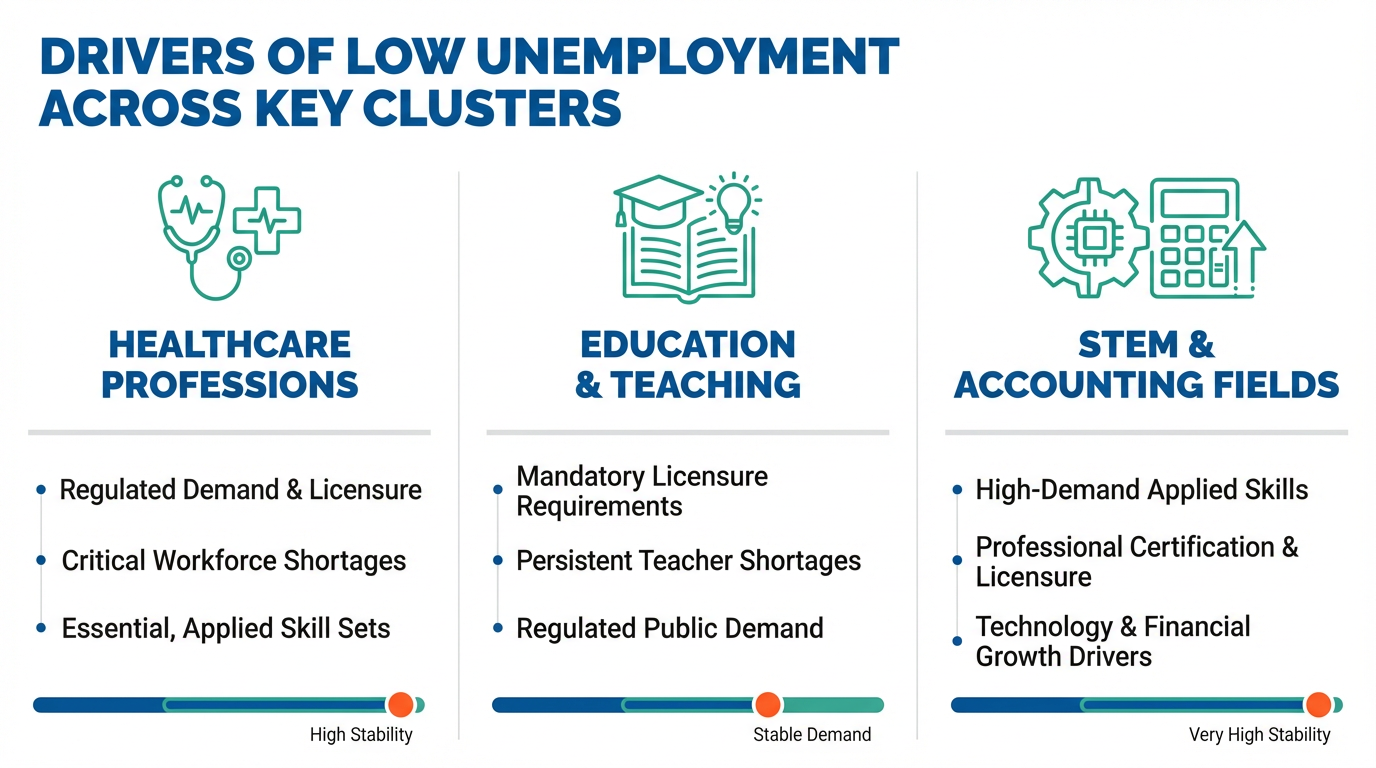
The gap widens dramatically when comparing individual academic fields. Healthcare and select STEM disciplines dominate the list of most stable career paths, with many majors with the lowest unemployment rate showing remarkably low jobless rates. These fields benefit from licensure requirements, chronic talent shortages, and regulated demand that creates predictable job opportunities. Whether you’re changing careers or entering college for the first time as an adult, understanding which programs lead to the most secure employment can guide your educational investment. Explore GetEducated’s database of over 35,000 accredited online degree programs to find the right path forward.
Top Majors With the Lowest Unemployment: What 2026 Graduates Should Know
When you’re ready to change careers and invest in your future, choosing a field with strong job security becomes a top priority. Recent data shows that certain fields consistently maintain the most stable employment outcomes, giving graduates a clear advantage in the job market. Understanding which college majors offer the best career prospects in 2026 can help you make a confident choice that aligns with both your interests and financial goals.
GetEducated's Picks
- Alvernia University Bachelor of Arts in Addictions & Mental Health Treatment
- Fisher College Bachelor of Arts in Early Childhood Education & Care
- Rochester Christian University Bachelor of Business Administration / Marketing
Healthcare Majors: Licensed Professionals Stay Employed
Healthcare fields with licensing standards maintain some of the most reliable career prospects nationwide. Recent New York Fed research confirms that nursing consistently shows unemployment rates well below the national average for college graduates. BSN nursing, radiologic technology, and pharmacy-related programs lead to regulated positions with predictable demand. These careers require specific credentials that limit competition and ensure steady demand for qualified professionals.
Nursing’s reach extends further than most realize. Most states participate in the Nurse Licensure Compact, which grants reciprocity across member states, meaning you can practice outside the state where you hold your license. This flexibility particularly benefits travel nurses, who command significantly higher salaries than staff nurses in traditional roles.
Education Fields: Teacher Shortages Create Opportunities
Beyond healthcare, education fields also demonstrate exceptional job security. Special education and bilingual/ESL instruction maintain strong employment outcomes due to persistent staffing shortages. The Bureau of Labor Statistics shows education majors benefit from state-backed hiring initiatives and federal funding programs. School districts actively recruit in these high-need areas, often offering signing bonuses and loan forgiveness. Necessary teaching licenses combined with ongoing shortages mean steady job opportunities for education graduates.
STEM and Professional Majors: Skills That Employers Need
Complementing these licensed professions, technical and professional fields offer equally promising prospects. Computer science, information systems, electrical engineering, and accounting show excellent employment outcomes when paired with practical experience. NCES data indicates these fields maintain jobless rates significantly below average. The key difference lies in applied learning components like internships, industry certifications, and employer partnerships. Programs that connect classroom theory with real-world applications consistently produce graduates who transition smoothly into full-time positions.
How To Choose a Major for Stable Employment (Without Guesswork)
When you’re changing careers and need to choose a major that leads to stable employment, you want concrete steps that remove uncertainty from your decision. Rather than hoping for the best, you can follow a proven framework that connects your degree directly to job security.
Here’s how to make this decision with confidence:
- Start with positions that require specific credentials. Look for majors that lead to professional licenses or certifications that employers are required to hire. Teaching programs end with state teaching certificates, and CACREP-accredited counseling programs include mandatory practicum hours for licensure eligibility. These credentials reduce hiring friction because employers know exactly what you can do.Note that licensure-track healthcare programs such as BSN, dental hygiene, and radiology are not available fully online; career switchers will need to begin with an in-person program. Online options in these fields are best suited for licensed professionals already in the field who want to advance into higher-level roles.
- Research your local job market before you commit. Use the BLS Field of Degree database to check employment projections in your target field, then check your state’s workforce reports and current job postings. A nursing shortage in Texas doesn’t guarantee the demand for ICU nurses in Vermont. The CareerOneStop License Finder helps you verify state-specific licensing requirements, so you know exactly what credentials you’ll need where you plan to work.
- Prioritize programs with hands-on learning components. Internships, clinicals, practicums, and employer-aligned projects typically lead to better job placement outcomes. STEM fields with applied learning show lower unemployment rates, and healthcare programs require clinical rotations that often lead directly to job offers. When evaluating programs, ask specifically about these practical experiences and how they’re arranged.
- Look for comprehensive student support beyond graduation. The strongest programs offer career services, job placement assistance, and ongoing professional development resources. Check whether your target program provides exam prep for licensing tests, maintains relationships with local employers, and tracks graduate employment rates. Use GetEducated’s degree search tool to compare these support features across different accredited programs before making your final decision.
Accredited Online Degrees With Low Unemployment Potential: What to Verify
Accreditation determines the value of your investment in online degree programs with low unemployment rates. For nursing, confirm both programmatic accreditation from CCNE or ACEN and state board approval for licensure eligibility—nursing programs without proper credentials won’t qualify you for the RN exam. Education majors need programs aligned with their state’s teacher certification requirements, while accounting students should verify coursework meets CPA exam eligibility if that’s their career path.
Beyond accreditation credentials, legitimate programs arrange local clinical placements or student teaching through vetted partners, not vague promises about “helping you find” opportunities. Get placement details in writing before enrolling, including partner locations, scheduling flexibility, and backup options. A quick call with an admissions advisor can reveal warning signs. Watch for unclear costs, unrealistic timelines, or evasive answers about accreditation status. Look for programs offering prior learning credit and transparent total costs that fit your budget and timeline.
FAQs: Degrees With the Best Job Security After Graduation
Career changers often wonder which degrees offer the best job security after graduation before committing to a program. The answers below use real employment data and graduate outcomes to guide your decision-making.
Do unemployment rates really vary between different majors?
Yes, unemployment rates differ significantly by field of study. According to the New York Fed’s research, recent graduates in healthcare, education, and engineering typically see unemployment rates below 3%, while some liberal arts fields may exceed 6%.
Does having a higher degree level automatically mean better job security?
Generally, yes. Bureau of Labor Statistics data shows that bachelor’s degree holders have consistently lower unemployment rates than those with only high school diplomas. However, your specific major and regional job market matter more than degree level alone.
Do professional licenses and certifications actually reduce unemployment risk?
Absolutely. Licensed professions like nursing, teaching, and accounting create regulated job markets with predictable demand. Once you complete the required education and pass licensing exams, you enter a regulated profession where employers must hire licensed practitioners.
Will employers treat my accredited online degree the same as a campus degree?
Most employers now view accredited online degrees equally to traditional ones. Research shows that hiring managers focus on accreditation, relevant skills, and work experience rather than on how you earned your degree. The key is choosing properly accredited programs.
What happens if I get licensed in one state and move to another?
For nurses, interstate practice is increasingly straightforward. Most states participate in the Nurse Licensure Compact, which allows you to practice in any member state under a single license — a major advantage for those who relocate or pursue travel nursing. For teachers, reciprocity is expanding as states compete for qualified candidates. The Education Commission of the States maintains state-by-state profiles on teacher license reciprocity, making it easy to check the rules wherever you plan to work.
How can I research job security for specific majors before enrolling?
Check the NCES employment data and your state’s workforce development reports for regional demand. Look at job postings in your target field and connect with professionals on LinkedIn. Consider using GetEducated’s major selection guide to evaluate options systematically.
Your Next Step: Compare Accredited Online Programs Confidently
Healthcare, education, and select STEM majors consistently show the lowest unemployment rates because they lead to licensure or fill persistent talent shortages. Your success depends on choosing approved programs that align with state requirements and include hands-on components.
To make informed decisions, create a simple comparison worksheet tracking each program’s credentials, licensing alignment, clinical arrangements, and total cost. Verify legitimacy through official sources. When you’re ready to compare accredited online degrees, GetEducated provides independent access to over 35,000 programs, helping you find the right fit for your goals and schedule.